

Building passive income sounds like a dream until you realize most advice out there is either outdated or requires a trust fund to get started. You want real strategies that work with limited capital, not vague promises about making money while you sleep.
The good news? There are legitimate ways to create income streams that keep paying you long after the initial work is done. Some take more upfront effort than others. All of them are accessible to beginners who are willing to put in the time.
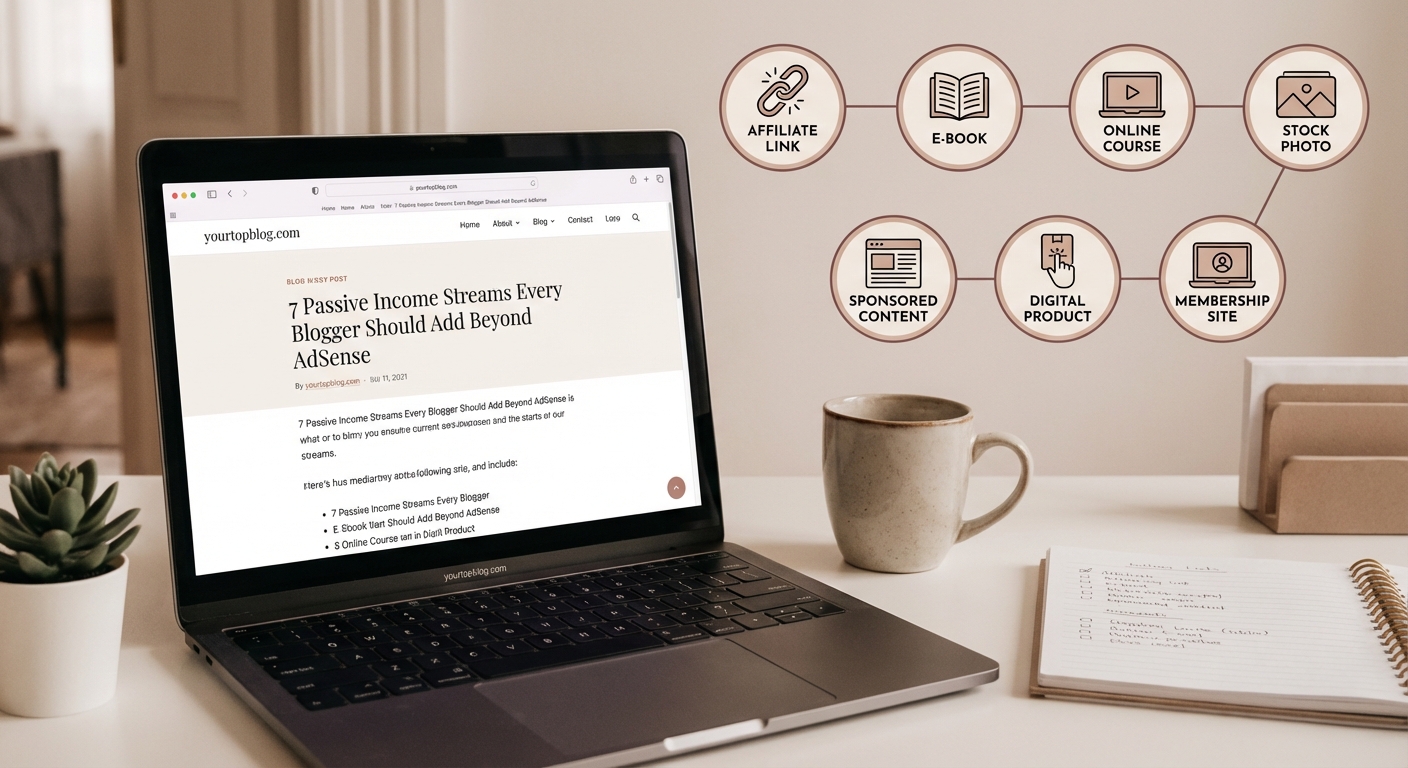
Building passive income requires upfront effort but pays dividends over time. The seven streams covered here include digital products, affiliate marketing, online courses, print on demand, stock content, membership sites, and automated services. Each offers different profit potential and time investment, making it possible to start with limited capital and scale based on your skills and available time.
What makes an income stream truly passive
Let’s clear something up right away. No income stream is 100% passive from day one.
You’ll need to invest time, energy, or money upfront. The magic happens when that initial investment continues generating returns without constant attention.
Think of it like planting a fruit tree. You dig the hole, water it regularly at first, and tend to it during those early months. Eventually, it produces fruit year after year with minimal maintenance.
The best passive income streams share three characteristics:
- They scale without requiring proportional time increases
- They generate revenue while you focus on other projects
- They compound over time as your assets grow
The worst passive income advice tells you to “just start a blog” or “create a course” without explaining the actual work involved. We’re going to be honest about both the effort required and the realistic returns.
Digital products that sell on autopilot

Digital products are the foundation of most successful passive income strategies. You create them once and sell them infinitely.
The beauty of digital products is the profit margin. No inventory costs. No shipping headaches. No physical overhead.
Here are the types that work best for beginners:
- Templates and worksheets for specific problems
- Checklists and planning tools
- Swipe files and resource libraries
A social media manager might sell Instagram caption templates. A fitness coach could offer meal planning spreadsheets. A project manager might create workflow templates.
The key is solving a specific problem for a defined audience. Generic products get ignored. Targeted solutions get purchased.
“I made my first digital product in a weekend. It was a simple budget spreadsheet for freelancers. Three years later, it still brings in $800 to $1,200 every month with zero additional work beyond occasional customer emails.” — Sarah Chen, freelance designer
Setting up your first digital product takes these steps:
- Identify a recurring problem your audience faces
- Create a simple solution in a downloadable format
- Set up automated delivery through platforms like Gumroad or Payhip
- Write a sales page that addresses specific pain points
- Promote it through your existing channels
You don’t need fancy design skills. Google Sheets, Canva, and basic PDF creation tools handle most digital product needs.
Affiliate marketing without the sleaze
Affiliate marketing gets a bad reputation because of pushy promoters who recommend products they’ve never used.
Done right, it’s just recommending tools and services you already use and getting compensated when people buy through your link.
The passive element comes from evergreen content. A blog post you write today about the best email marketing tools can generate affiliate commissions for years.
Here’s what actually works:
- Write comparison posts between tools in your niche
- Create tutorial content showing how to use specific products
- Build resource pages listing your favorite tools by category
- Include affiliate links naturally in case studies and examples
The mistake most beginners make is promoting too many products. Pick five to ten tools you genuinely use and know inside out. Become the go-to expert for those specific solutions.
| Strategy | Time to profit | Difficulty | Income potential |
|---|---|---|---|
| Product reviews | 3-6 months | Medium | $500-$5,000/month |
| Tutorial content | 2-4 months | Low | $200-$3,000/month |
| Comparison posts | 4-8 months | High | $1,000-$10,000/month |
| Resource pages | 6-12 months | Medium | $300-$4,000/month |
The numbers vary wildly based on your niche, audience size, and traffic sources. A small email list of engaged subscribers often outperforms a large blog with casual readers.
Online courses that teach what you know
You already know something valuable. The question is whether you can package that knowledge into a structured learning experience.
Online courses represent one of the highest-earning passive income streams. They also require the most upfront work.
A single course can generate anywhere from a few hundred to several hundred thousand dollars. The wide range depends on your audience size, pricing strategy, and course quality.
The process looks like this:
- Validate your course idea by asking your audience what they struggle with
- Create an outline breaking your knowledge into logical modules
- Record video lessons or write detailed text-based lessons
- Set up your course on platforms like Teachable, Podia, or Thinkific
- Create a simple sales funnel to convert visitors into students
You don’t need expensive equipment. A decent microphone and screen recording software handle most course creation needs. Many successful courses use simple slide presentations with voiceover.
The passive element comes from evergreen courses that don’t require constant updates. Teaching fundamental skills works better than covering rapidly changing topics.
A course on writing compelling sales copy stays relevant for years. A course on the latest social media algorithm changes becomes outdated in months.
Print on demand for creative types
Print on demand lets you sell physical products without holding inventory. You upload designs, and when someone orders, a third party prints and ships the item.
This works for:
- T-shirts and apparel
- Mugs and home goods
- Phone cases and accessories
- Wall art and posters
- Notebooks and stationery
The profit margins are smaller than digital products, but the market is massive. People love buying products with clever designs, funny quotes, or niche references.
Your job is creating designs that resonate with specific audiences. A design that appeals to dog owners, marathon runners, or math teachers will outperform generic graphics every time.
Platforms like Printful, Printify, and Redbubble handle the production and shipping. You focus on design and marketing.
The most successful print on demand sellers create collections around themes rather than random individual designs. Ten related designs for yoga enthusiasts perform better than ten unrelated designs.
Stock content that earns royalties
If you create photos, videos, music, or graphics, stock content sites pay royalties every time someone licenses your work.
The income per download is small, usually between $0.25 and $5. The passive magic comes from volume and longevity.
A single photo can sell hundreds of times over several years. Upload enough quality content, and those small payments add up to meaningful income.
Popular stock content platforms include:
- Shutterstock for photos and videos
- Adobe Stock for diverse media types
- Pond5 for video footage
- AudioJungle for music and sound effects
The key is creating content that businesses actually need. Generic sunset photos won’t cut it. Specific business scenarios, diverse people in professional settings, and niche concepts get downloaded more frequently.
Think about what marketing teams, bloggers, and designers search for. A photo of a diverse team collaborating in a modern office has more commercial value than a pretty landscape.
Quality matters more than quantity. Ten excellent, commercially viable images outperform a hundred mediocre snapshots.
Membership sites for ongoing value
Membership sites charge recurring fees for access to exclusive content, community, or resources.
This model trades some passivity for higher, more predictable income. You’ll need to add new content regularly, but the structure allows for systematic creation rather than constant hustle.
Successful membership sites typically offer:
- A library of resources that grows over time
- Regular new content on a predictable schedule
- Community access for members to connect
- Live sessions or office hours (optional)
The monthly recurring revenue model means you know roughly what you’ll earn each month. Ten members at $50 per month equals $500 in predictable income.
The challenge is retention. Members will cancel if they don’t see ongoing value. This makes membership sites less passive than one-time purchase products but more stable than project-based income.
A good middle ground is creating a membership site with a large library of existing content and adding new material monthly. Members get immediate value from the archive while staying for the new releases.
Automated service businesses
This might sound contradictory. How can a service business be passive?
The answer is systemization and automation. You’re not trading hours for dollars. You’re building systems that deliver value with minimal ongoing input.
Examples include:
- Automated email courses that nurture leads
- Software tools that solve specific problems
- Licensing your methodology or framework to others
- Creating done-for-you templates and systems
A copywriter might create an email course teaching business owners how to write better sales pages. The course runs automatically, delivering lessons on a schedule and occasionally converting students into paying clients.
A designer could build a tool that automatically generates color palettes based on brand keywords. Users pay a monthly fee for access.
The initial setup requires significant work. Building the system, creating the automation, and testing everything takes time. Once it’s running, maintenance is minimal.
This approach works best when you’ve already delivered a service manually and understand the process inside out. You’re not guessing at what people need. You’re automating what you already know works.
Common mistakes that kill passive income
Most people fail at building passive income because they make predictable mistakes. Avoid these and you’re already ahead of most beginners.
Starting too many streams at once. Pick one, build it properly, then add another. Spreading yourself thin means nothing gets built well enough to generate real income.
Expecting immediate results. Passive income takes time to build momentum. Most streams need three to six months before generating meaningful revenue. Some take longer.
Ignoring your audience. Creating products nobody wants wastes time. Ask your audience what they struggle with. Build solutions for real problems, not imagined ones.
Underpricing everything. Charging $7 for something that provides $700 worth of value makes building passive income nearly impossible. Price based on value delivered, not arbitrary low numbers.
Giving up too early. The difference between people who build successful passive income and those who don’t often comes down to persistence. Keep refining and promoting until something clicks.
Building your first stream this month
You don’t need to implement all seven streams. Start with one that matches your skills and current situation.
If you’re a strong writer, affiliate marketing and digital products make sense. If you’re creative, print on demand or stock content might fit better. If you have deep expertise, an online course or membership site could work.
The goal isn’t perfection. It’s progress. Your first digital product won’t be amazing. Your first course will have rough edges. That’s fine.
Launch it anyway. Get feedback. Improve it. Then start building your second stream.
The people earning serious passive income didn’t get there by waiting for perfect conditions. They started with what they had, learned from mistakes, and kept building.
Your first stream might earn $50 a month. That’s $50 more than you had before. Six months later, it might be $200. A year later, $800. Add a second stream, then a third, and suddenly you’ve built something meaningful.
The best time to start was six months ago. The second best time is today.