

You built a blog that gets traffic. Now you want to turn that traffic into real money. But relying on one income source feels risky, and you’re not sure how to add more without annoying your readers or spreading yourself too thin.
The good news? You don’t need to choose between making money and keeping your audience happy. You can build several income streams that complement each other, support your content, and grow your business without turning your site into a billboard.
Creating multiple revenue streams means layering compatible monetization methods that serve the same audience. Start with one proven model, add complementary streams only after the first is stable, and prioritize methods that enhance rather than interrupt the user experience. The goal is sustainable income diversity, not maximum monetization at the expense of trust.
Why Single Revenue Streams Put Your Business at Risk
Depending on one income source means one algorithm change, one policy update, or one market shift can wipe out your earnings overnight.
AdSense accounts get suspended. Affiliate programs shut down. Sponsors cut budgets. Platforms change their terms without warning.
Bloggers who built their entire business on a single revenue model have watched their income drop to zero in a single day. Not because they did anything wrong, but because they had no backup plan.
Multiple revenue streams create stability. When one dips, others keep you afloat. When one grows, it funds experiments with new models.
But there’s a catch. Adding too many revenue streams at once overwhelms you and confuses your audience. The solution is strategic layering.
The Foundation Model Approach

Before you add multiple streams, you need one that works reliably.
Your foundation model should match your traffic level, audience trust, and content type. For most bloggers, this means starting with display ads, affiliate marketing, or sponsored content.
Display ads work best when you have consistent traffic above 10,000 monthly visitors. They require almost no maintenance once set up. You write content, visitors see ads, you earn money.
Affiliate marketing works at any traffic level if you recommend products your audience actually needs. You build trust by solving problems, then suggest tools that help. Common mistakes like avoiding proper placement and testing can cost you thousands in lost revenue.
Sponsored content works when you have an engaged audience and clear expertise. Brands pay you to create content that showcases their products to your readers.
Pick one. Master it. Get it to a point where it generates predictable monthly income. Only then should you add a second stream.
How to Layer Revenue Streams Without Overwhelming Readers
The secret to adding income sources is compatibility. Each new stream should enhance what you already offer, not compete with it.
Here’s how to think about it:
Complementary streams support each other. If you run display ads, adding affiliate links to product reviews makes sense. Both monetize your content without requiring extra reader action.
Competing streams cannibalize each other. If you run ads and also try to sell the same products directly, you’re fighting yourself for the same dollar.
Enhancement streams add value. If you create free content, offering a paid course that goes deeper serves readers who want more. You’re not taking anything away from free users.
Start by mapping what you already do well. Then look for natural extensions.
If you write tutorials, you could add affiliate links to tools you mention, create a paid advanced course, or offer one-on-one consulting. All three serve the same audience at different commitment levels.
If you run a review site, you could combine display ads with affiliate programs and sponsored reviews. Each monetizes different reader behaviors without conflict.
“The best revenue streams feel invisible to readers who aren’t ready to buy, and helpful to those who are. If your monetization makes people trust you less, you’re doing it wrong.” – Anonymous seven-figure blogger
The Practical Revenue Stream Stacking Process
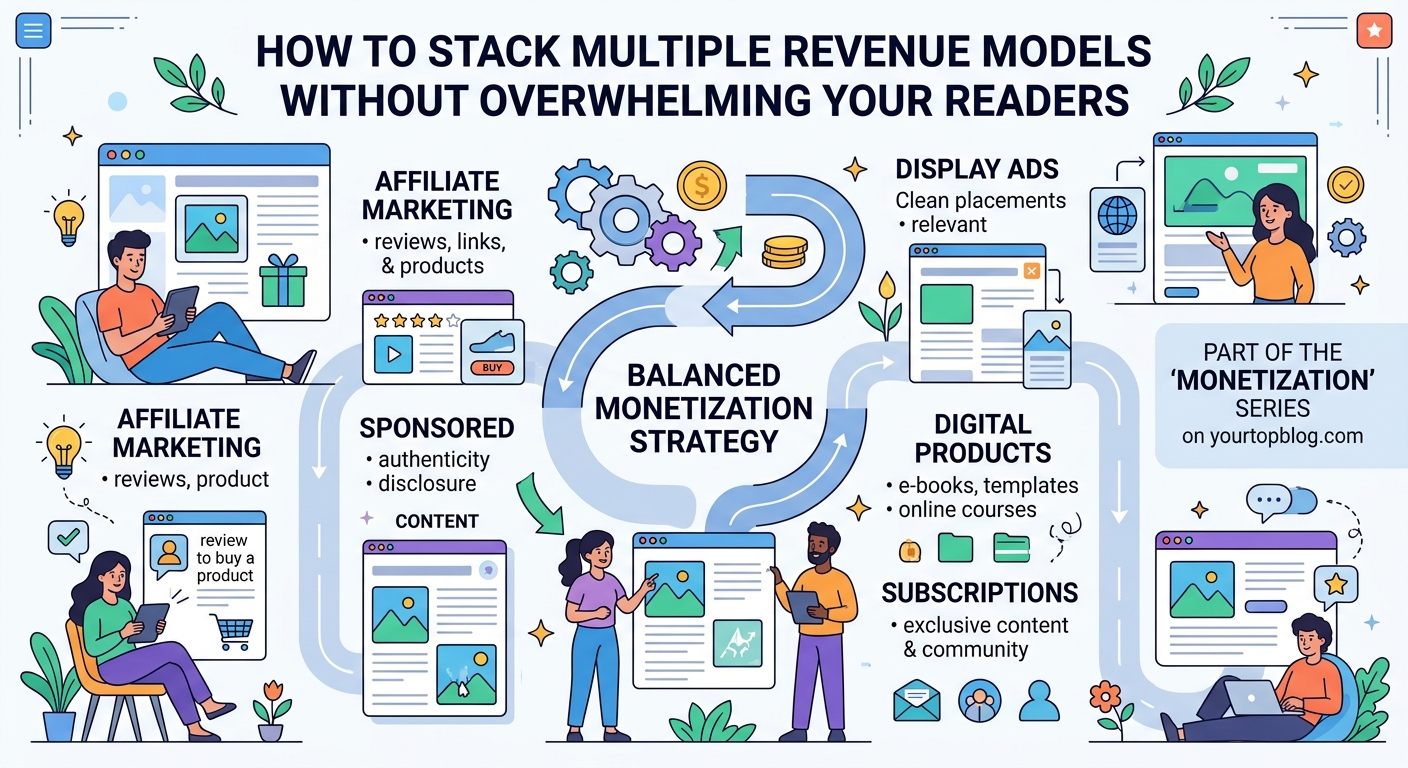
Here’s exactly how to add income sources without chaos:
-
Stabilize your foundation stream first. Get it earning consistent monthly income for at least three months. Track the numbers. Understand what drives revenue up or down.
-
Identify your audience’s next need. What do your readers ask for that you don’t provide? What problems remain unsolved after they read your content?
-
Choose one complementary stream. Pick something that serves the same audience but monetizes a different behavior or intent level.
-
Test with minimal disruption. Add the new stream to a small section of your site first. Monitor how it affects user experience and existing revenue.
-
Measure everything separately. Track each revenue stream independently so you know what’s working and what’s not.
-
Optimize before expanding. Get the new stream performing well in its test area before rolling it out site-wide.
-
Wait three months before adding another. Give yourself time to learn the new model and let your audience adjust.
This process prevents the overwhelm that kills most diversification attempts. You’re building systematically, not randomly adding money-making tactics.
Revenue Stream Compatibility Matrix
Not all income sources work well together. Some enhance each other. Others compete for attention and dollars.
| Revenue Stream | Works Well With | Conflicts With | Best For |
|---|---|---|---|
| Display Ads | Affiliate links, Email list building | Direct product sales, Paywalls | High traffic sites (10k+ monthly visitors) |
| Affiliate Marketing | Display ads, Tutorials, Reviews | Competing direct sales | All traffic levels with engaged readers |
| Sponsored Content | Affiliate marketing, Display ads | Too many other ads | Established authority in a niche |
| Digital Products | Email marketing, Free content | Heavy ad placements | Audiences seeking deep solutions |
| Memberships | Exclusive content, Community | Full paywalls on all content | Loyal, engaged communities |
| Consulting | Educational content, Case studies | Low-ticket products | Small, high-value audiences |
Use this to plan your stack. If you run display ads, affiliate marketing fits naturally. If you sell digital products, membership upsells make sense.
Avoid combinations that fight each other. Don’t run heavy ads on pages where you’re trying to sell your own course. Don’t offer consulting if you’re positioning yourself as a beginner.
Common Revenue Streams Worth Considering
Let’s break down the options most bloggers should consider:
Display advertising generates passive income from traffic. You place ad code on your site, and networks like Google AdSense or Mediavine show relevant ads. You earn money per impression or click. This works best for content sites with growing traffic.
Affiliate marketing pays you commissions when readers buy products you recommend. You join programs, get unique links, and earn a percentage of sales. Programs like those covered in guides about high-converting affiliate options can significantly boost income when matched to your audience.
Digital products include ebooks, courses, templates, and tools you create once and sell repeatedly. These offer the highest profit margins but require upfront work and audience trust.
Sponsored content means brands pay you to create articles, videos, or social posts featuring their products. This works when you have clear expertise and audience engagement metrics to show.
Membership programs charge recurring fees for exclusive content, community access, or special perks. These create predictable income but require ongoing value delivery.
Services and consulting trade your time for money at premium rates. This doesn’t scale like other models but works well for experts with specialized knowledge.
Email courses and lead magnets build your list while positioning you as an authority. You can monetize the list later through product launches or affiliate promotions.
Each stream has different requirements for traffic, trust, and time investment. Match them to where you are now, not where you hope to be someday.
Traffic Requirements for Different Revenue Models
Your traffic level determines which streams make sense right now:
-
Under 5,000 monthly visitors: Focus on affiliate marketing and building your email list. Display ads won’t generate meaningful income yet. Consider creating your first digital product if you have a specific expertise.
-
5,000 to 25,000 monthly visitors: Add display ads through networks like AdSense. Continue affiliate marketing. Test sponsored content if you have engagement metrics. Start planning a course or membership.
-
25,000 to 100,000 monthly visitors: Upgrade to premium ad networks like Mediavine or AdThrive. Scale affiliate marketing. Actively pursue sponsored content deals. Launch digital products or memberships.
-
Over 100,000 monthly visitors: Optimize all existing streams. Consider direct ad sales. Launch multiple products. Explore licensing or media opportunities.
Don’t jump ahead. Trying to sell courses with 1,000 visitors usually fails because you don’t have enough data about what your audience needs. Building traffic through methods like finding low competition keywords should come first.
The Email List as Revenue Stream Multiplier
Every revenue stream performs better when you have an email list. Your list is the only audience you truly own.
Social platforms change algorithms. Search engines update rankings. But your email list stays yours. You can reach subscribers directly, without paying for access or competing for attention.
Build your list from day one, even before you monetize. Offer something valuable in exchange for email addresses. A free guide, checklist, template, or mini-course works well.
Then use your list to:
- Promote affiliate products with personal recommendations
- Launch digital products to a warm audience
- Share new content that earns ad revenue
- Announce sponsored content partnerships
- Offer exclusive deals or early access
An email subscriber is worth 10 to 100 times more than a random visitor over their lifetime. Treat list building as a revenue stream itself, even though it generates money indirectly.
Avoiding the Monetization Mistakes That Kill Trust
More revenue streams don’t always mean more money. Done wrong, they reduce income by damaging reader trust.
Mistake one: Adding too many streams at once. Your site becomes cluttered. Readers feel overwhelmed. You can’t optimize anything because you’re managing too much.
Mistake two: Promoting low-quality products for commissions. You might make a few sales, but you lose credibility. Once trust is gone, all your revenue streams suffer.
Mistake three: Letting ads dominate the experience. Pages that load slowly or bury content under ads drive readers away. Lower traffic means less revenue across all streams.
Mistake four: Hiding valuable content behind paywalls too early. You need free content to build trust and traffic. Paywall everything, and you lose both.
Mistake five: Inconsistent content quality. When you’re chasing money instead of serving readers, quality drops. Readers notice and leave.
Mistake six: Ignoring user experience data. If bounce rates spike or time on page drops after adding a revenue stream, that stream is costing you money overall.
Track your metrics. If a new revenue stream hurts user experience, remove it or adjust the implementation. No single stream should damage your foundation.
Real Examples of Successful Revenue Stack Combinations
Let’s look at what actually works in practice:
The tutorial blog stack: Free tutorials monetized with display ads and affiliate links to recommended tools. Email list offers a paid advanced course. This works because each stream serves readers at different skill levels.
The review site stack: Product reviews with affiliate links, display ads on comparison content, and occasional sponsored reviews for premium brands. All three monetize the same content without competing.
The authority site stack: Free educational content builds traffic and trust. Display ads monetize casual readers. Email list promotes a membership community for serious learners. Consulting services for businesses who need custom help. Each level serves different commitment and budget levels.
The niche blog stack: Focused content on a specific topic attracts targeted traffic. Affiliate marketing for relevant products. Digital product (course or ebook) for deeper learning. Sponsored content from brands in the niche. Everything aligns with the core topic.
Notice the pattern? Successful stacks serve the same audience with compatible offers. They don’t throw random monetization at the wall hoping something sticks.
When to Add Your Next Revenue Stream
Timing matters as much as selection. Add streams too early, and you’re overwhelmed. Wait too long, and you leave money on the table.
Here are the signals that you’re ready:
- Your current revenue stream generates consistent monthly income
- You understand why it works and can predict fluctuations
- You have time to implement and optimize something new
- You’ve identified a clear audience need not met by current streams
- Your traffic or engagement is growing steadily
- You have data showing what your audience wants next
If any of these aren’t true, focus on optimizing what you have rather than adding something new.
The best time to add a revenue stream is when your current one feels easy to manage and you’re confident you could grow it further if needed. That confidence means you’ve mastered the model.
Measuring Success Across Multiple Streams
Once you have several revenue sources, tracking becomes critical. You need to know what’s working, what’s not, and where to focus your effort.
Track these metrics for each stream separately:
- Monthly revenue: The actual dollars earned
- Revenue per visitor: How efficiently each stream monetizes traffic
- Time investment: Hours spent managing or optimizing
- Revenue per hour: Which streams give the best return on your time
- Growth rate: Which streams are trending up or down
- User impact: How each affects bounce rate, time on site, and return visitors
Most bloggers track total revenue but ignore efficiency. You might have a stream that generates $500 monthly but takes 20 hours to manage. That’s $25 per hour. Another stream might generate $300 with one hour of monthly work. That’s $300 per hour.
Focus your optimization time on high-efficiency streams. Consider dropping or automating low-efficiency ones, even if they generate decent absolute revenue.
The Role of Passive Income in Your Stack
Not all revenue streams require the same ongoing effort. Understanding the difference helps you build a sustainable business.
Truly passive streams generate income with minimal ongoing work after setup. Display ads and affiliate links in evergreen content fall here. You create the content once, and it earns money for months or years.
Semi-passive streams need regular but minimal maintenance. Email sequences promoting products, membership sites with stable content, and digital products with automated delivery fit this category.
Active streams require ongoing work for each dollar earned. Sponsored content, consulting, and services fall here. You stop working, the income stops.
A healthy stack includes mostly passive and semi-passive streams, with a small percentage of active income. This gives you stability without tying your income to your daily hours.
Many bloggers make the mistake of chasing active income because it feels more controllable. But trading hours for dollars limits your growth. Passive streams scale without scaling your time investment.
Building Systems That Support Multiple Streams
Managing several revenue sources gets messy without systems. You need processes that let you track, optimize, and maintain everything without constant manual work.
Create a simple spreadsheet that tracks:
- Each revenue stream’s monthly income
- Traffic to monetized pages
- Conversion rates for affiliate links and products
- Time spent on each stream
- Notes on what you changed and results
Review this monthly. Look for patterns. Which streams grow together? Which compete? What small changes led to big results?
Set up automated reporting where possible. Most ad networks and affiliate programs email monthly reports. Digital product platforms track sales automatically. Consolidate these into one place so you can see the full picture.
Schedule specific times for optimization work. Don’t randomly tweak things. Pick one stream per month to focus on improving. This prevents the scattered effort that leads to burnout.
Your Next Steps for Building Multiple Revenue Streams
You don’t need to implement everything at once. Start where you are with what you have.
If you’re just starting out, focus on building traffic and starting one foundation revenue stream. Get that working before adding anything else.
If you have one stream working, identify the most compatible second stream based on your audience’s next biggest need. Implement it in a limited way first.
If you have multiple streams already, audit them. Which ones actually make money relative to the effort? Which could you optimize or eliminate?
The goal isn’t to have the most revenue streams. It’s to have the right combination that generates reliable income without overwhelming you or annoying your readers.
Building multiple revenue streams is like constructing a building. You need a solid foundation before adding floors. Each level must support the next. Rush the process, and everything collapses.
Take your time. Build strategically. Test before committing. And always prioritize your audience’s experience over short-term revenue. The trust you build becomes the foundation for every stream you add later.