

Finding keywords that actually rank feels impossible when you’re starting out. Every term you check seems dominated by massive sites with endless budgets and years of authority.
But here’s the truth: thousands of valuable keywords exist right now with low competition and real search volume. You just need to know where to look and what signals matter.
Low competition keywords are search terms with manageable difficulty scores, weak SERP competition, and genuine user intent. By combining keyword tools, competitor gap analysis, and community research, you can identify terms that drive traffic without requiring massive backlink profiles or [domain authority](https://en.wikipedia.org/wiki/Domain_authority). Focus on long-tail variations, question-based queries, and topics where current results lack depth or quality.
Understanding what makes a keyword truly low competition
Most people confuse low search volume with low competition. They’re not the same thing.
A low competition keyword has fewer authoritative sites targeting it. The pages currently ranking might have weak backlinks, thin content, or poor user experience. Sometimes the top results don’t even match search intent properly.
Search volume matters, but a keyword with 200 monthly searches and zero competition beats one with 5,000 searches where you’ll never crack page two.
Keyword difficulty scores help, but they’re just estimates. Tools like Ahrefs, SEMrush, and Ubersuggest calculate these based on backlink profiles of ranking pages. A score below 30 generally signals opportunity, but always verify manually.
Check the actual search results. Open an incognito window and search your target term. Look at the top 10 results. Are they all massive brands? Do they have thousands of backlinks? Or do you see forum threads, outdated blog posts, and pages that barely answer the question?
That manual check reveals more than any metric.
Starting your research with seed topics
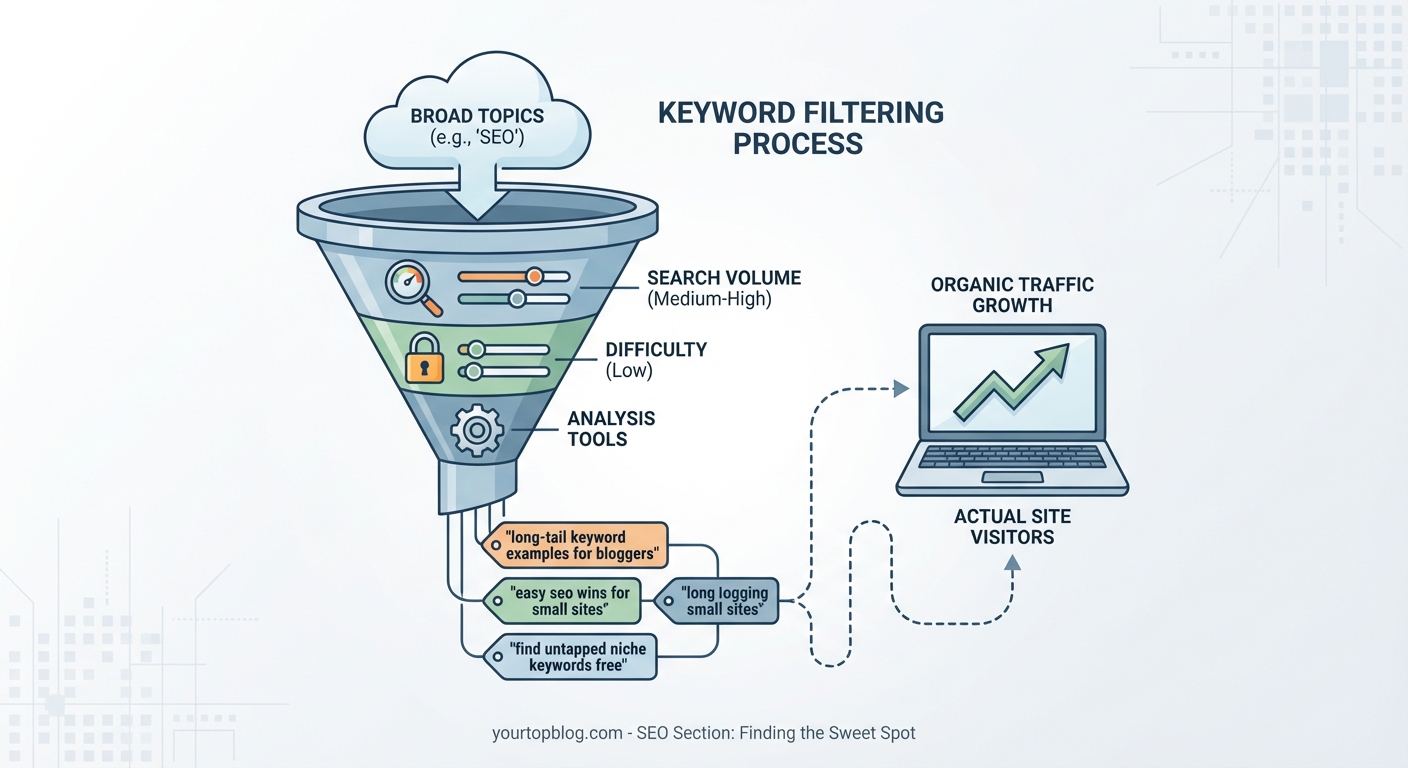
Begin with broad topics related to your niche. Don’t jump straight into tools.
Think about what your audience actually needs help with. If you run a gardening blog, your seed topics might include container gardening, pest control, seasonal planting, or soil health.
Write down 5 to 10 core topics. These become your foundation for finding specific keyword opportunities.
Now expand each topic with modifiers:
- How to
- Best ways to
- Tips for
- Common mistakes
- Without [pain point]
- For beginners
- Step by step
A seed topic like “container gardening” becomes “how to start container gardening for beginners” or “container gardening mistakes to avoid.”
These longer phrases naturally have less competition because fewer sites target them specifically.
Using keyword research tools the right way
Free tools work fine when you’re starting. Google Keyword Planner, Ubersuggest’s limited free version, and Answer the Public all provide useful data.
Paid tools give you more depth. Ahrefs, SEMrush, and Mangools KWFinder show keyword difficulty, SERP analysis, and related terms in one dashboard.
Here’s a simple process:
- Enter your seed topic into your chosen tool
- Filter results by keyword difficulty (aim for scores under 30)
- Set minimum search volume (50 to 100 monthly searches minimum)
- Export promising terms to a spreadsheet
- Add columns for difficulty, volume, and your manual SERP assessment
Don’t just grab the first terms that appear. Sort by different metrics. Sometimes a keyword with slightly higher difficulty but much better intent deserves priority.
Look for question-based keywords. Terms starting with “how,” “why,” “what,” “where,” and “when” often signal strong intent and face less competition.
“The best keywords aren’t always the ones with the highest volume. They’re the ones where you can genuinely provide better answers than what currently ranks.” – Content strategist insight
Analyzing search intent before committing
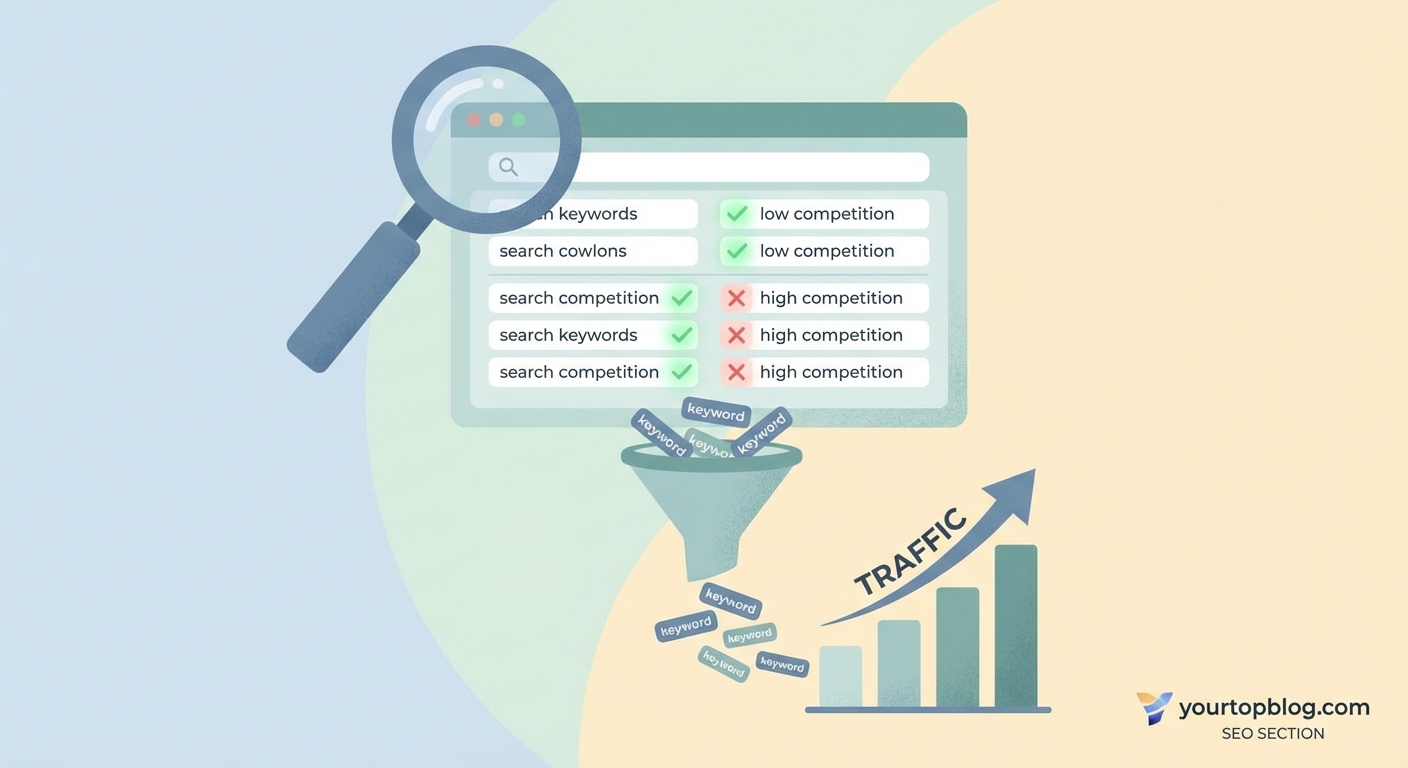
Search intent determines whether a keyword will actually convert visitors into readers, subscribers, or customers.
Four main intent types exist:
- Informational: User wants to learn something
- Navigational: User seeks a specific site or page
- Commercial: User researches before buying
- Transactional: User ready to purchase or take action
Match your content type to intent. If someone searches “best running shoes,” they’re comparing options (commercial intent). Your review or comparison post fits perfectly.
If they search “how to tie running shoes,” they need a tutorial (informational intent). Trying to sell them shoes in that article fails.
Check the current top results. What format dominates? Lists, tutorials, reviews, or product pages? Google rewards content that matches what users actually want.
When intent seems mixed, create content that serves the primary need first, then addresses secondary questions.
Finding gaps in competitor content
Your competitors already did keyword research. Use their work as a shortcut.
Identify 3 to 5 sites in your niche that rank well but aren’t massive authorities. Enter their domains into Ahrefs Site Explorer or SEMrush’s Domain Overview.
Look at their organic keywords report. Filter for:
- Keywords where they rank in positions 4 to 20
- Terms with difficulty scores under 30
- Keywords bringing them actual traffic
These represent opportunities. They’re ranking but not dominating. You can create better, more comprehensive content and potentially outrank them.
Use the Content Gap tool (available in most SEO platforms). Enter your domain and 2 to 3 competitor domains. The tool shows keywords they rank for that you don’t.
Filter these results the same way. Focus on low difficulty terms where you can realistically compete.
Mining forums and communities for hidden keywords
Reddit, Quora, Facebook groups, and niche forums contain goldmines of keyword ideas that never appear in traditional tools.
People ask real questions using natural language. They describe problems in ways that reveal search intent perfectly.
Visit subreddits related to your niche. Read the top posts from the past month. Note the questions people ask repeatedly. Those repeated questions signal demand.
Use site search operators in Google:
- site:reddit.com [your topic]
- site:quora.com [your topic]
Scan the results for question patterns. If multiple threads discuss “why does my sourdough starter smell like acetone,” that’s a specific, low competition keyword opportunity.
Facebook groups work similarly. Join active communities and observe conversations. Screenshot or note questions that appear frequently.
These community-sourced keywords often have:
- Low competition (big sites ignore them)
- Clear intent (real people asking real questions)
- Engaged audiences (proven interest)
Evaluating SERP features and ranking difficulty
SERP features change how hard it is to get traffic, even if you rank well.
Featured snippets, People Also Ask boxes, local packs, and video carousels all steal clicks from organic results.
Search your target keyword. Count how many SERP features appear above the first organic result. More features mean less traffic potential, even if you rank #1.
Some SERP features create opportunities though. If a featured snippet exists but provides a weak answer, you can target it with better-structured content.
Check the domain authority of ranking pages using MozBar or similar browser extensions. If most top 10 results have domain authority below 40, you have a realistic shot.
Look at the content depth. Open the top 3 results. How long are they? How thoroughly do they cover the topic? If they’re all 500-word surface-level posts, you can win with a comprehensive 1,500-word guide.
Prioritizing keywords with a scoring system
You’ll find dozens or hundreds of potential keywords. You need a system to choose which ones to target first.
Create a simple scoring system in your spreadsheet:
| Factor | Low Score (1) | Medium Score (2) | High Score (3) |
|---|---|---|---|
| Difficulty | Above 40 | 30 to 40 | Below 30 |
| Search Volume | Under 50 | 50 to 200 | Above 200 |
| Intent Match | Unclear | Partial | Perfect |
| SERP Weakness | Strong results | Mixed quality | Weak results |
| Relevance | Tangential | Related | Core topic |
Score each keyword across these factors. Multiply the total by any priority multipliers (like seasonal relevance or monetization potential).
Target the highest-scoring keywords first. This ensures you’re working on terms with the best chance of success.
Review and update your scores quarterly. Competition changes. A keyword that seemed impossible six months ago might be accessible now.
Building content that actually ranks
Finding the keyword is half the battle. Creating content that ranks requires strategy.
Your content needs to be better than what currently ranks. Not just longer, but genuinely more helpful.
Include these elements:
- Clear answer to the main question in the first 200 words
- Subheadings that cover related questions people ask
- Examples, screenshots, or visuals that clarify concepts
- Personal experience or case studies when relevant
- Internal links to related content on your site
- External links to authoritative sources
Match the content format to what ranks. If the top results are all lists, create a better list. If they’re tutorials, make a clearer tutorial.
Use your target keyword naturally in:
- The title
- At least one H2 heading
- The first paragraph
- The conclusion
- Image alt text
But never force it. Write for humans first. Search engines reward content that genuinely helps people.
Tracking results and doubling down on winners
Publish your content, then monitor its performance.
Use Google Search Console to track:
- Which keywords you’re ranking for
- Your average position for each term
- Click-through rates
- Impressions versus clicks
Give content at least 3 to 6 months to gain traction. SEO takes time, especially for newer sites.
When a piece starts ranking on page two (positions 11 to 20), optimize it. Add more depth, update outdated information, improve internal linking, and build a few quality backlinks.
Small improvements often push borderline content onto page one.
Track which types of keywords work best for your site. If question-based keywords consistently rank faster, prioritize more of them. If location-specific terms perform well, expand that approach.
Double down on what works. If a particular content format or topic cluster drives results, create more in that vein.
Common mistakes that kill your ranking chances
Even with perfect keyword research, certain mistakes sabotage your efforts.
Avoid these common errors:
- Targeting keywords with no search volume just because difficulty is low
- Ignoring search intent and creating the wrong content type
- Stuffing keywords unnaturally throughout your content
- Publishing thin content (under 800 words for most topics)
- Neglecting internal linking between related posts
- Forgetting to optimize images and load speed
- Giving up after two months when rankings take six
| Mistake | Why It Fails | Better Approach |
|---|---|---|
| Chasing only high volume | Impossible to rank without authority | Target 50+ monthly searches with low difficulty |
| Ignoring user intent | Google won’t rank mismatched content | Check top results and match format |
| Thin content | Can’t compete with comprehensive guides | Aim for 1,200+ words on most topics |
| No internal links | Wastes existing authority | Link new posts to related content |
| Impatience | SEO needs 3 to 6 months minimum | Track progress but wait for results |
The biggest mistake? Not starting at all because everything seems too competitive.
Thousands of bloggers rank for valuable keywords every single day. Most started exactly where you are now.
Your next steps for ranking success
You now have a complete system for finding and targeting low competition keywords.
Start with one seed topic today. Run it through a keyword tool. Export 10 promising terms. Manually check the SERPs for each one. Choose your best opportunity and create genuinely helpful content around it.
Repeat this process weekly. Build a content library targeting winnable keywords. Track your results. Refine your approach based on what works for your specific site and niche.
The sites dominating search results today all started somewhere. They built authority one low competition keyword at a time, proving their value to readers and search engines alike.
Your turn starts now.