

You’ve been promoting affiliate products for months. The traffic is there. The clicks are happening. But your bank account tells a different story.
Low conversion rates are the silent killer of affiliate marketing dreams. You’re doing the work, but the commissions aren’t following. The problem isn’t always about traffic volume or the products you’re promoting. Most of the time, it’s about the disconnect between what your audience needs and how you’re presenting your offers.
Affiliate links fail to convert when there’s a mismatch between audience intent, product relevance, and trust signals. Success comes from understanding your visitor’s journey, placing links strategically, creating genuine recommendations, and optimizing for the right metrics. Small changes in placement, context, and timing can dramatically improve your conversion rates without needing more traffic.
You’re Sending Cold Traffic to Hot Offers
Here’s the truth: most affiliate marketers treat every visitor the same.
Someone landing on your blog post about “best running shoes for beginners” is in a completely different mindset than someone reading “how to start running.” The first person is ready to buy. The second person is still learning.
When you drop affiliate links into content without considering where your reader is in their journey, you’re asking them to make decisions they’re not ready for.
The awareness stages matter:
- Problem-aware readers know they have an issue but haven’t identified solutions
- Solution-aware readers are comparing different approaches
- Product-aware readers are evaluating specific options
- Most-aware readers just need the final push to purchase
Match your affiliate promotions to these stages. Educational content works for early-stage readers. Product comparisons and reviews work for later stages. Trying to sell a $500 course to someone who just learned the problem exists yesterday? That’s why your links aren’t converting.
Your Content Lacks Trust Signals
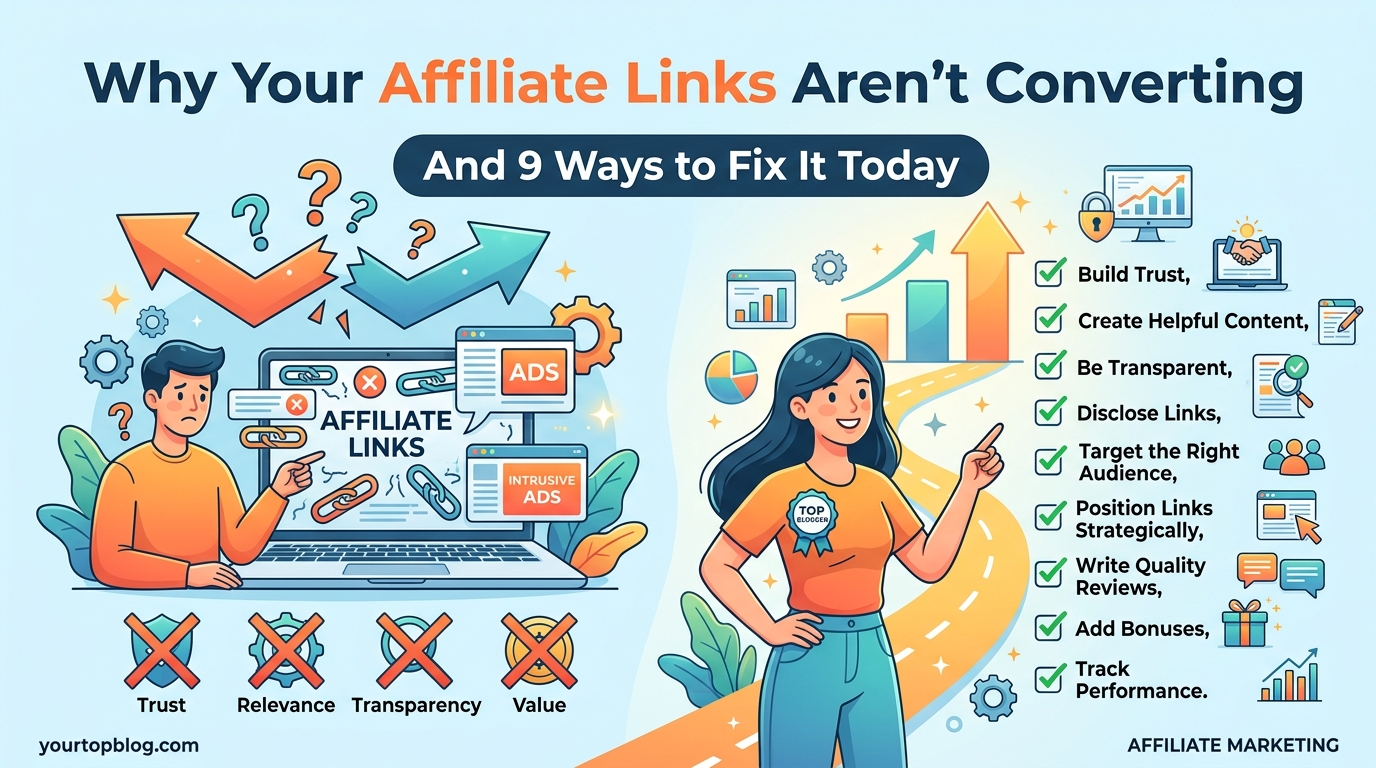
People don’t buy from strangers on the internet.
They buy from people who’ve proven they know what they’re talking about. If your affiliate content reads like a sales page copied from the merchant’s website, readers can smell it from a mile away.
Trust signals include:
- Personal experience with the product
- Specific use cases and results
- Honest drawbacks and limitations
- Screenshots or photos showing actual usage
- Comparison with alternatives you’ve also tested
I’ve seen affiliate sites increase conversions by 40% just by adding a single paragraph about how they personally use the product. That’s the power of authenticity.
The best affiliate content doesn’t feel like affiliate content. It feels like advice from a friend who genuinely wants to help you solve a problem.
You’re Promoting the Wrong Products
Not every affiliate program is worth your time.
Some products have terrible conversion rates no matter how well you promote them. High commissions mean nothing if nobody buys. The math is simple: a 50% commission on zero sales is still zero dollars.
| Product Type | Typical Conversion Rate | Red Flags |
|---|---|---|
| Software trials | 2-5% | Complicated signup, credit card required upfront |
| Physical products | 3-8% | Poor reviews, shipping issues, outdated designs |
| Digital courses | 1-3% | Unknown creator, no refund policy, vague promises |
| Subscription services | 4-7% | Hidden fees, difficult cancellation, bad support |
Before you commit to promoting something, check the merchant’s sales page yourself. Would you buy from that page? If the answer is no, your audience won’t either.
Sometimes switching to programs that actually convert well makes more difference than any optimization you could do on your own site.
Your Call-to-Action Is Invisible or Aggressive
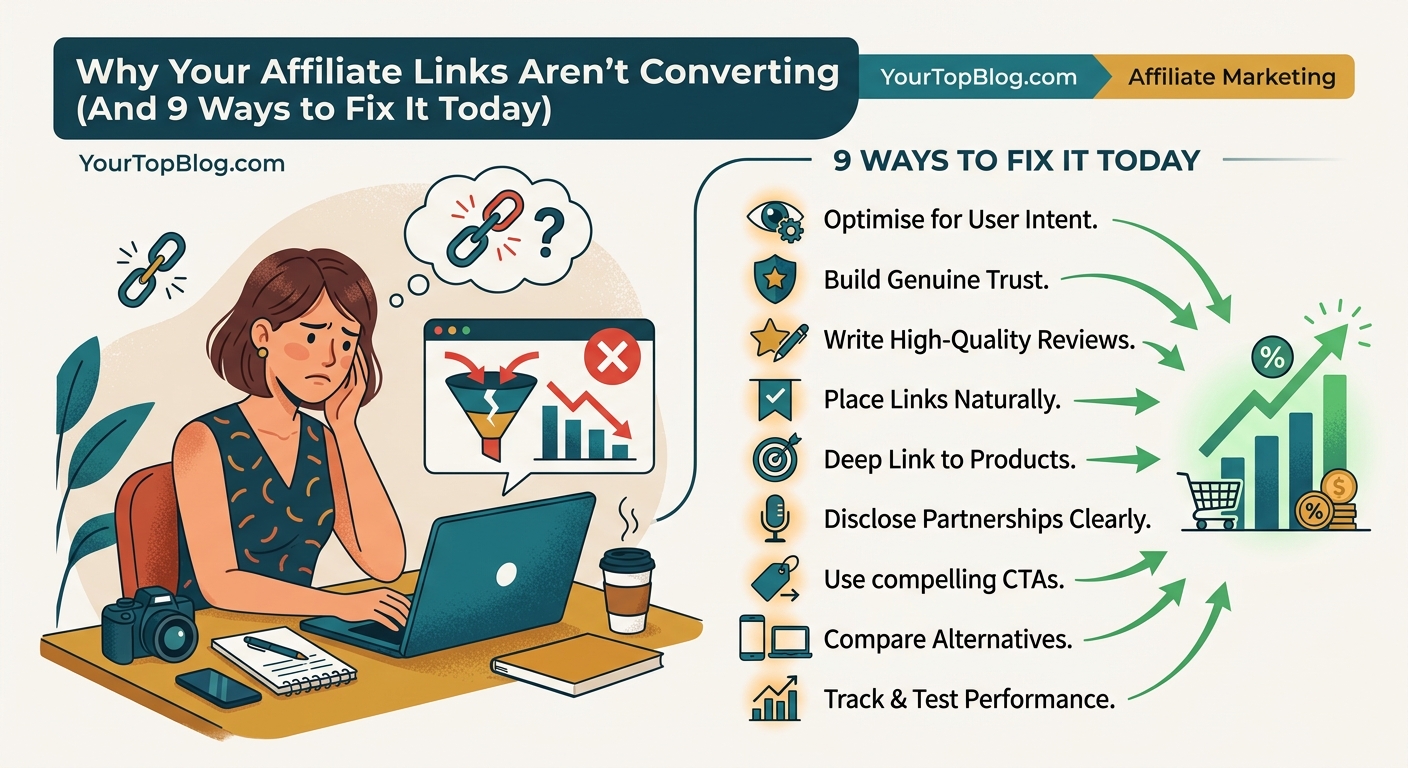
There’s a sweet spot between hiding your affiliate links and shoving them in people’s faces.
Too subtle, and readers miss them completely. Too aggressive, and you trigger their sales resistance. Finding that balance is where conversions happen.
Effective CTA placement follows this pattern:
- Introduce the problem in the opening paragraphs
- Provide genuine value and education in the middle
- Present your affiliate solution as the natural next step
- Make the link visible but contextual
- Remind readers of the benefit, not just the product name
Button text matters too. “Click here” converts worse than “See current pricing on Amazon” or “Try it free for 30 days.” Specific actions beat generic commands every time.
And here’s something most people miss: you need multiple CTAs in longer content. Someone reading paragraph three might be ready to buy. Someone else needs to read to the end. Give both groups opportunities to convert.
You’re Ignoring Mobile Users
Over 60% of web traffic comes from mobile devices.
If your affiliate links are hard to tap, buried in dense paragraphs, or lead to non-mobile-friendly merchant pages, you’re losing more than half your potential conversions.
Mobile optimization isn’t just about responsive design. It’s about understanding how people browse on phones:
- They scroll fast and scan aggressively
- They hate typing and filling out forms
- They abandon pages that load slowly
- They can’t hover over links to see where they go
- They’re often browsing in short bursts between other activities
Make your affiliate links thumb-friendly. Use buttons instead of text links when it makes sense. Ensure the merchant’s checkout process works smoothly on mobile. Test your own content on your phone before you publish.
The same content that converts at 5% on desktop might convert at 1% on mobile if you haven’t optimized for the experience.
Your Traffic Sources Don’t Match Your Offers
Where your visitors come from determines what they’re willing to buy.
Pinterest traffic behaves differently than Google search traffic. Reddit users have different expectations than Instagram followers. Email subscribers trust you more than random organic visitors.
Traffic source conversion patterns:
- Search traffic: High intent, ready to buy, needs product-specific content
- Social media: Lower intent, needs education first, relationship-building matters
- Email subscribers: Highest trust, converts on recommendations, values exclusivity
- Paid traffic: Expensive, needs immediate value match, very sensitive to friction
If you’re getting most of your traffic from low competition keywords but promoting high-ticket items that need extensive trust-building, there’s a mismatch. Those informational searchers need nurturing before they’re ready to buy.
The solution isn’t always changing your traffic sources. Sometimes it’s about adjusting which products you promote to which audiences.
You’re Not Testing Anything
Guessing is expensive in affiliate marketing.
What works on one site might fail on another. What converts in one niche might bomb in a different category. The only way to know what works for your specific audience is to test.
Elements worth testing:
- Link placement (beginning vs. middle vs. end)
- Anchor text (product name vs. benefit-focused)
- Button color and size
- Content length (short reviews vs. comprehensive guides)
- Disclosure placement and wording
- Number of affiliate links per page
You don’t need fancy software to start. Just create two versions of your top-performing posts and track which one generates more affiliate clicks and sales. Give each version at least 1,000 visitors before drawing conclusions.
Small improvements compound. A 10% increase in click-through rate plus a 10% increase in merchant conversion rate equals a 21% increase in your commissions. Those numbers add up fast.
Your Content Doesn’t Answer the Real Question
People search for solutions, not products.
When someone types “best blender for smoothies” into Google, they’re not just looking for product names. They want to know which blender will actually make their morning routine easier without breaking their budget or taking up too much counter space.
If your content is just a list of affiliate links with basic specs copied from Amazon, you’re not answering the real question. You’re creating noise, not value.
The content that converts addresses:
- Specific use cases and scenarios
- Common mistakes and how to avoid them
- What to expect in the first week, month, year of use
- Who this product is NOT right for
- Alternatives at different price points
This approach works because it demonstrates expertise. It shows you understand the reader’s actual situation. And it makes your recommendation feel earned, not bought.
You’re Competing on the Wrong Battlefield
Some affiliate keywords are dominated by sites with massive budgets and authority.
Trying to rank for “best web hosting” when you’re a six-month-old blog is like bringing a knife to a gunfight. You might have better content, but you’ll never outrank the established players who’ve been building links for years.
The smarter play is finding angles those big sites ignore:
- Specific niches within broader categories
- Problem-solution content instead of product roundups
- Long-tail variations with clearer intent
- Comparison posts between less-popular alternatives
- Use-case-specific recommendations
A post about “best budget web hosting for photography portfolios” has less competition than “best web hosting” but attracts readers who are much closer to making a purchase decision. They’re also more likely to trust a specialized recommendation.
Building traffic through strategic growth tactics often means avoiding head-to-head competition with authority sites.
Your Disclosure Feels Like a Warning
Affiliate disclosures are legally required and ethically important.
But the way you write them affects how readers perceive your recommendations. A disclosure that sounds apologetic or defensive triggers skepticism. One that sounds confident and transparent builds trust.
Compare these two approaches:
Defensive: “This post contains affiliate links. I might earn a small commission if you buy something, but it doesn’t cost you anything extra.”
Confident: “I recommend products I’ve personally tested and believe will help you. Some links are affiliate partnerships, which helps keep this site running at no extra cost to you.”
The second version frames your affiliate relationship as a value exchange, not something to apologize for. It acknowledges the business relationship while emphasizing your commitment to genuine recommendations.
Place your disclosure where it’s visible but not the first thing readers see. You want them to engage with your content before they’re thinking about your monetization strategy.
You’re Measuring the Wrong Metrics
Click-through rate doesn’t pay your bills.
You can have a 10% CTR on your affiliate links and still make no money if those clicks don’t convert on the merchant’s site. The metrics that actually matter are:
- Earnings per click (EPC)
- Conversion rate on merchant site
- Average order value
- Return visitor rate
- Email capture rate for future promotions
Some affiliate programs provide detailed analytics. Others give you almost nothing. But you should at least be tracking which posts generate actual commissions, not just clicks.
I’ve seen posts with half the traffic outperform “popular” posts by 3x in revenue because they attracted the right visitors with the right intent. Traffic volume is vanity. Revenue is reality.
If you’re also running ads alongside affiliate content, watch out for common monetization mistakes that can hurt both revenue streams.
Your Follow-Up Strategy Is Missing
Most people don’t buy on their first visit.
They need to see your recommendation multiple times, from multiple angles, before they’re ready to commit. If you’re only promoting products in single posts and hoping for immediate conversions, you’re leaving money on the table.
A complete follow-up strategy includes:
- Email sequences that nurture new subscribers with helpful content
- Related posts that reinforce the same recommendations from different angles
- Seasonal promotions when products go on sale
- Case studies showing long-term results with the products you promote
- Updated reviews that reflect new features or changes
This is where diversifying your income streams becomes powerful. Email subscribers who trust your recommendations will convert at much higher rates than cold traffic.
The affiliate marketers making serious money aren’t relying on single-touch conversions. They’re building relationships that lead to multiple purchases over time.
Stop Guessing and Start Converting
Fixing affiliate conversion rates isn’t about working harder or getting more traffic.
It’s about working smarter. Understanding your audience’s journey. Matching the right products to the right content. Building genuine trust through transparency and expertise. Testing what works and doubling down on winners.
Start with one change today. Pick your best-performing post and audit it against the issues we’ve covered. Is the product right for the audience? Is the placement optimal? Does the content build enough trust? Make one improvement, track the results, and move to the next.
Your affiliate income is waiting on the other side of these fixes. The traffic you already have can convert better. You just need to remove the barriers standing between your readers and the solutions they’re searching for.