
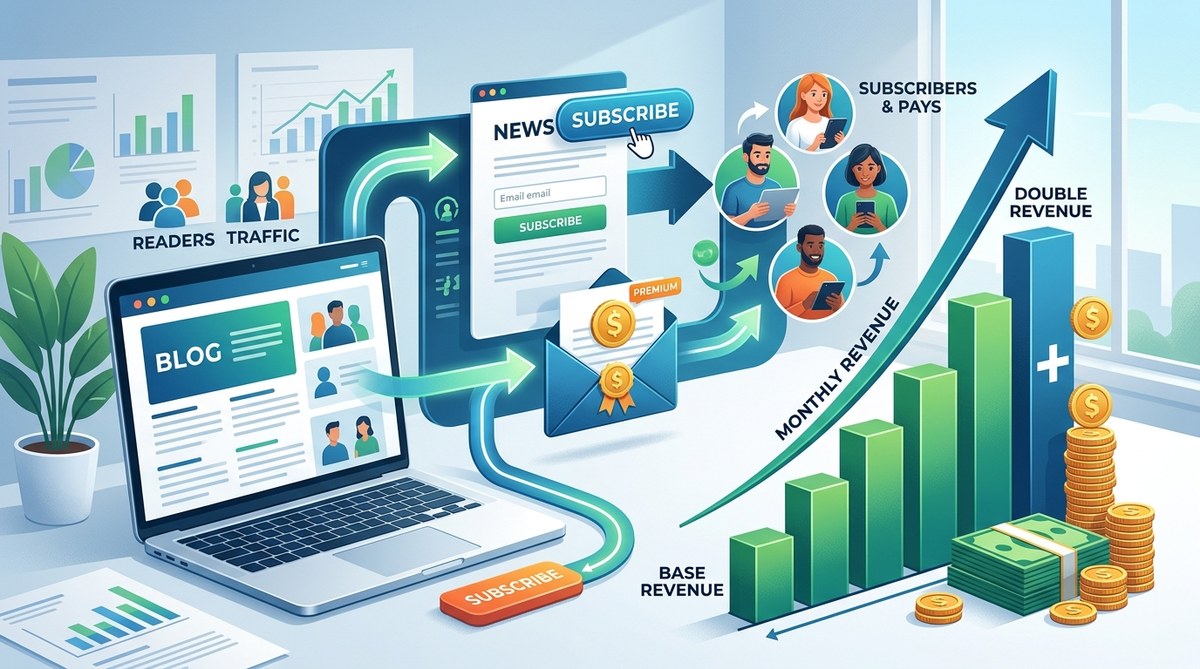
You already have an audience. You have monetization experience. You know that display ads and affiliate links alone won’t get you to full-time income, or if they do, it takes massive traffic. A paid newsletter changes the math. Instead of needing 100,000 visitors to make $3,000 a month, you can earn the same with 300 loyal subscribers paying $10 a month. This guide walks through the exact steps to launch a paid newsletter that can double your current blog revenue.
A paid newsletter converts your most engaged readers into a reliable income stream. The strategy works best when you already have a blog with traffic and an email list. Start by defining a premium topic, choose a platform like ConvertKit or Substack, set a price between $7 and $15 a month, and deliver exclusive content weekly. Track your conversion rate and subscriber churn to optimize over time.
Why a Paid Newsletter Beats Other Revenue Streams
Most bloggers rely on one or two income sources. If your AdSense RPM drops or an affiliate program changes its terms, your income takes a hit. A paid newsletter is different. It gives you predictable, recurring revenue. You are not trading time for money with each post. You are building an asset that pays you every month as long as you keep your subscribers happy.
Think about the math. If you have a blog with 20,000 monthly visitors and you convert just 1.5 percent of your email list into paid subscribers, that could mean 150 people paying $10 a month. That is $1,500 in extra monthly revenue. Add that to your existing AdSense or affiliate income, and you have a serious boost. For more ideas on diversifying, read about 7 passive income streams every blogger should add beyond AdSense.
Step 1: Define Your Premium Content Angle
Your paid newsletter cannot just be a rehash of your blog posts. Subscribers pay for something they cannot get for free. You need a clear premium angle.
Here are three proven angles that work:
- Deeper tutorials. If your blog covers how to start a garden, your paid newsletter could include monthly live Q&A sessions, printable planting calendars, and early access to new guides.
- Data and analysis. If you write about affiliate marketing, your paid newsletter could share your monthly income reports, the exact campaigns that worked, and the tools you use.
- Community and accountability. Some bloggers charge for access to a private community where members get feedback, support, and direct access to you.
Choose one angle that matches your expertise and your audience’s biggest needs. Do not try to do all three at once.
Step 2: Choose the Right Platform
You need a platform that handles payments, email delivery, and subscriber management. Here are the top options compared in a simple table:
| Platform | Best For | Starting Price | Key Feature |
|---|---|---|---|
| ConvertKit | Bloggers with existing email lists | $9 per month | Visual automation and subscriber tagging |
| Substack | Writers who want minimal setup | Free (takes 10% cut) | Built-in audience discovery |
| Memberful | Bloggers using WordPress or Stripe | $25 per month | Integrates with any site via Stripe |
| Ghost | Tech-savvy bloggers who want full control | $9 per month | Open source, no third-party cut |
I recommend ConvertKit for most bloggers. It gives you the most control over your email list and lets you segment free subscribers from paid ones. If you want something simpler, Substack works well, but you lose the ability to export your list easily.
Step 3: Set Your Price Point
Pricing a newsletter feels uncomfortable at first. You worry that people will not pay. The truth is, your most loyal readers already trust you. They want more from you.
Here is a simple pricing framework:
- Monthly plan. Set this between $7 and $15. At $10 a month, the annual value is $120. That is a price most people spend on coffee in a week.
- Annual plan. Offer a discount. Charging $100 a year instead of $120 gives subscribers a 17 percent savings and gives you upfront cash.
- Lifetime option. Some creators offer a lifetime access tier for $300 to $500. This works well if you have a small, dedicated audience.
Start with a monthly and annual option only. Add a lifetime tier after you have 50 subscribers.
Step 4: Create Your Welcome Sequence
When someone subscribes, they should get immediate value. Do not make them wait a week for the first email. Set up a welcome sequence that delivers your best premium content in the first three days.
Your welcome sequence should include:
- Email 1 (Day 1): A thank you message with a link to your most popular premium post or a downloadable resource.
- Email 2 (Day 2): A personal story about why you started the newsletter and what they can expect each week.
- Email 3 (Day 3): A request for feedback. Ask what their biggest challenge is right now.
This sequence builds trust and reduces the chance that they cancel within the first month.
Step 5: Promote Your Paid Newsletter to Your Existing Audience
You do not need to find new readers. Your existing blog audience is your best source of paid subscribers.
Use these promotion methods:
- Dedicated blog post. Write a post explaining exactly what subscribers get. Include a table comparing free content vs. premium content.
- Email list announcement. Send an email to your free list with a subject line like “I started something new and I think you will love it.”
- Sidebar signup form. Add a simple form on your blog that says “Get the premium version” with a link to your sales page.
- Social media teasers. Share small snippets of your premium content on Instagram or Twitter. Tell people the full version is in the paid newsletter.
Do not be shy about promoting it. Your readers want to support you. They just need to know the option exists.
For more on growing your free list first, check out the complete guide to building an email list that drives repeat traffic.
Step 6: Deliver Consistently and Track Your Metrics
Consistency matters more than perfection. If you promise a weekly newsletter, send it every week. If you promise monthly, send it every month. Your subscribers paid for reliability.
Track these three metrics:
- Conversion rate. The percentage of your free email list that becomes paid subscribers. A good rate is between 1 and 3 percent.
- Churn rate. The percentage of subscribers who cancel each month. Aim for under 5 percent monthly churn.
- Open rate. Paid newsletters often have open rates above 60 percent. If yours drops below 40 percent, your content may not be hitting the mark.
Review these numbers every month. If your churn is high, ask your subscribers what they want more of. If your conversion rate is low, improve your sales page or offer a limited-time discount.
Common Mistakes That Kill Paid Newsletters
Avoid these errors from the start:
- Charging too little. A $3 newsletter feels like a tip jar. Charge enough that subscribers feel they are buying something valuable.
- Promising too much. Do not say you will send daily emails if you cannot keep that pace. Start with weekly and scale up.
- Neglecting the free list. Your free email list is your pipeline. Keep adding value to it so people want to upgrade.
- Not having a clear premium angle. If your paid content is too similar to your free content, people will cancel.
“The biggest mistake I see is creators who underprice their newsletter because they are afraid of rejection. Your best readers will gladly pay for your expertise. Trust them.” – A blogger who grew a paid newsletter to $5,000 a month in under a year.
Your Action Plan for the Next 30 Days
You can launch a paid newsletter in one month. Here is the exact plan:
- Week 1: Choose your premium angle and pick your platform. Write your sales page.
- Week 2: Set up your welcome sequence and pricing. Record a short video introducing the newsletter.
- Week 3: Announce the newsletter to your free email list. Add a signup form to your blog sidebar.
- Week 4: Send your first paid issue. Ask for feedback and adjust your content plan.
Do not overthink this. The first version will not be perfect. You will learn more from 10 paying subscribers than from months of planning.
How to Scale From There
Once you have 50 to 100 paid subscribers, look for ways to grow further:
- Referral program. Give subscribers a free month for every person they refer who pays for a year.
- Bundle with other products. If you sell digital products or courses, offer a discount when someone subscribes to the newsletter.
- Guest appearances. Bring in experts from your niche for exclusive interviews. This adds variety and value.
If you want to see how other revenue models stack up, read should you charge for premium content a data-driven decision framework.
Turning Your Newsletter Into a Real Income Stream
A paid newsletter is not a side project. It is a serious revenue stream that can double your blog income if you treat it like a business. The key is starting. You already have the audience. You already have the expertise. Now you just need to package it into a subscription that your readers will happily pay for.
Set a date 30 days from today. Launch your paid newsletter by then. Your future self will thank you for the recurring income and the stronger connection with your most loyal readers.