
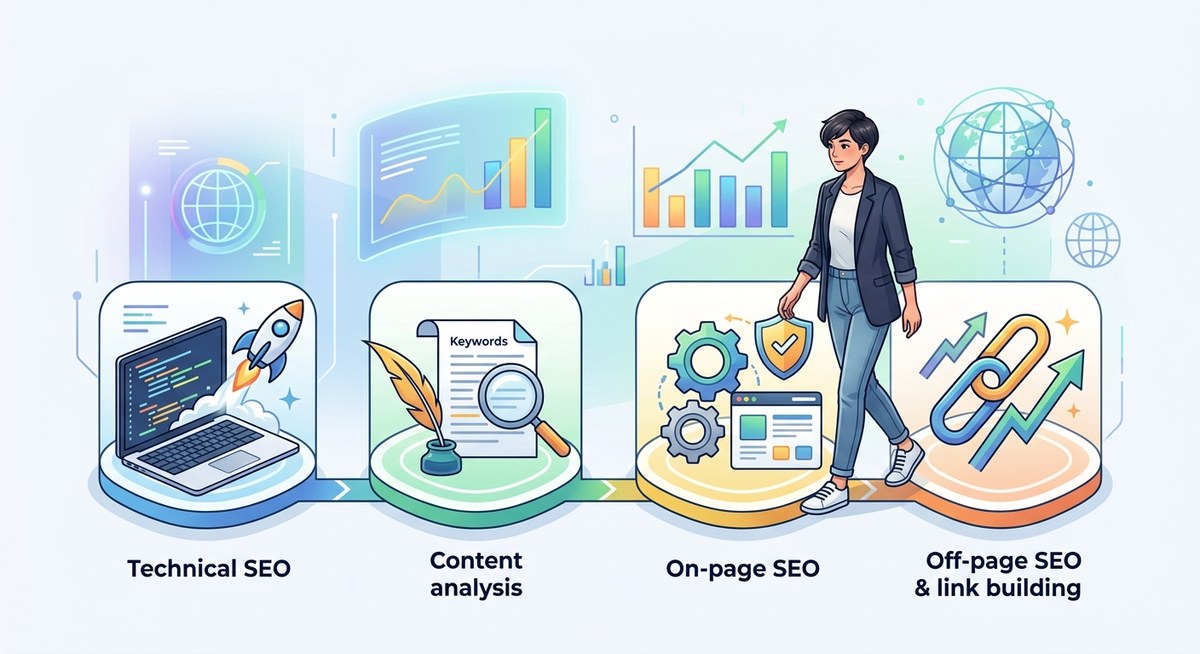
You already know that SEO is the lifeblood of organic traffic. But when was the last time you actually ran a full audit? Not just checking your rankings in Google Search Console, but a proper, systematic review of your site’s health. If your traffic has plateaued or your AdSense RPM feels stuck, the problem is usually hiding in one of four areas. This SEO audit checklist 2026 walks you through each one, step by step.
A proper SEO audit in 2026 is not about finding every tiny error. It is about fixing the handful of issues that block Google from understanding, ranking, and sending traffic to your best content. This guide provides a repeatable 4-step process covering technical health, on-page optimization, content quality, and backlink analysis. You will finish with a clear action plan.
Step 1: The Technical Health Check
Before you touch a single blog post, you need to make sure Google can actually find and read your site. This is the foundation. If the crawl fails, nothing else you do matters.
- Run a site-wide crawl. Use a tool like Screaming Frog (free version works for small sites) or a cloud-based crawler like Sitebulb. Look for 404 errors, broken internal links, and redirect chains. A page that returns a 404 is a dead end for both users and search engines.
- Check your index coverage in Google Search Console. Look at the “Pages” report. Are there valid pages marked as “Excluded”? Sometimes Google excludes pages for reasons like “Crawled – currently not indexed.” That is a red flag that the page might be too thin or have a poor user experience.
- Test Core Web Vitals. Google has been using these metrics for a while now, but many bloggers still ignore them. Run your top 10 traffic pages through PageSpeed Insights. Focus on Largest Contentful Paint (LCP) and Cumulative Layout Shift (CLS). Aim for LCP under 2.5 seconds.
- Verify your XML sitemap. Submit your sitemap in Google Search Console. Make sure it only includes pages you want indexed. No tag archives, no author pages, no thin affiliate landing pages.
Expert tip: If you see a sudden drop in indexed pages after a site migration or theme change, stop everything. Fix the index coverage problem first. Everything else is wasted effort until Google can find your content again.
Step 2: On-Page SEO and Content Diagnosis
Once the technical foundation is solid, turn your attention to the pages themselves. This is where most bloggers waste time by optimizing for the wrong keywords.
- Audit title tags and meta descriptions. Every page on your site should have a unique title tag. Use a simple spreadsheet to track them. If you find duplicate title tags, that is a sign of a deeper content strategy problem.
- Check for keyword cannibalization. Search for your primary keyword in a site search like
site:yourdomain.com "keyword". If multiple pages rank for the same term, Google has to choose one. Often, it picks the wrong one. Consolidate those pages or add canonical tags. - Review heading structure. Your H2s should break up the content logically. They are not just for SEO. They help readers scan. A page with a single H1 and no H2s is hard to read.
The table below shows common on-page mistakes and how to fix them.
| Mistake | Why It Hurts | Fix |
|---|---|---|
| Thin content (under 300 words) | Google sees no value. | Expand or merge the page. |
| Keyword stuffing in headings | Looks spammy. Hurts CTR. | Write natural, descriptive headings. |
| Missing alt text on images | Lost opportunity for image search. | Add descriptive alt text to every image. |
| Affiliate links without disclosure | Legal risk and trust erosion. | Add a clear disclosure statement. |
Step 3: Content Performance and Freshness
Your old content is an asset. But only if it is still accurate and useful. An audit in 2026 must include a content inventory.
- Identify your top 20 traffic pages. Go to Google Analytics and sort by organic traffic. For each page, ask: Is the information still correct? Does it have a clear call to action? Is it better than the current top-ranking result?
- Update outdated statistics and examples. If a post references “2024 data” or a tool that no longer exists, update it. Google rewards freshness, especially for “how to” and “best of” queries.
- Add internal links from your best performers. If you have a post that gets 5,000 visits a month, link it to two or three newer, less popular posts. This passes link equity and helps Google discover your newer content.
Expert tip: Do not delete old posts unless they are harmful (spammy, plagiarized, or policy-violating). Instead, redirect them to a similar, better page. A 301 redirect preserves most of the link value.
Step 4: Backlink Profile and Off-Page Signals
You cannot control who links to you, but you can clean up the mess. A toxic backlink profile can drag down your entire site.
- Run a backlink audit. Use a free tool like Ahrefs Webmaster Tools or Ubersuggest. Look for links from spammy sites, link farms, or irrelevant directories. These are called toxic links.
- Disavow the bad links. If you find a pattern of unnatural links (like a sudden spike of 500 links from the same domain), add them to Google’s Disavow Tool. Only do this if you have clear evidence of spam. Most sites do not need a disavow file.
- Analyze your anchor text distribution. If 80% of your backlinks use the same anchor text (“best coffee maker”), that looks unnatural. A healthy profile has a mix of branded, generic, and exact-match anchors.
Creating Your Action Plan from the Audit
An audit is only useful if you turn findings into tasks. Do not try to fix everything at once. Prioritize based on impact.
- Fix all broken links and 404 errors first. These are the easiest to fix and have immediate user experience benefits.
- Update your top 5 traffic pages. This will give you the biggest return on your time investment.
- Review your index coverage weekly for the next month. Make sure new pages are being added and nothing is dropping out.
If you want to go deeper into any of these areas, check out our guide on the complete on-page SEO checklist for bloggers in 2026 or learn how to find low competition keywords that actually drive traffic.
Your Next Audit Starts Today
You do not need to spend a full weekend on this. Block out two hours. Run the technical crawl. Update one old post. Check your top backlinks. That is enough to see a measurable difference in your organic traffic within a few weeks. The key is consistency. Run this SEO audit checklist 2026 once a quarter, and your site will stay healthy, your rankings will hold, and your traffic will grow. Start today. Pick one step and do it right now. You will thank yourself in 30 days.