
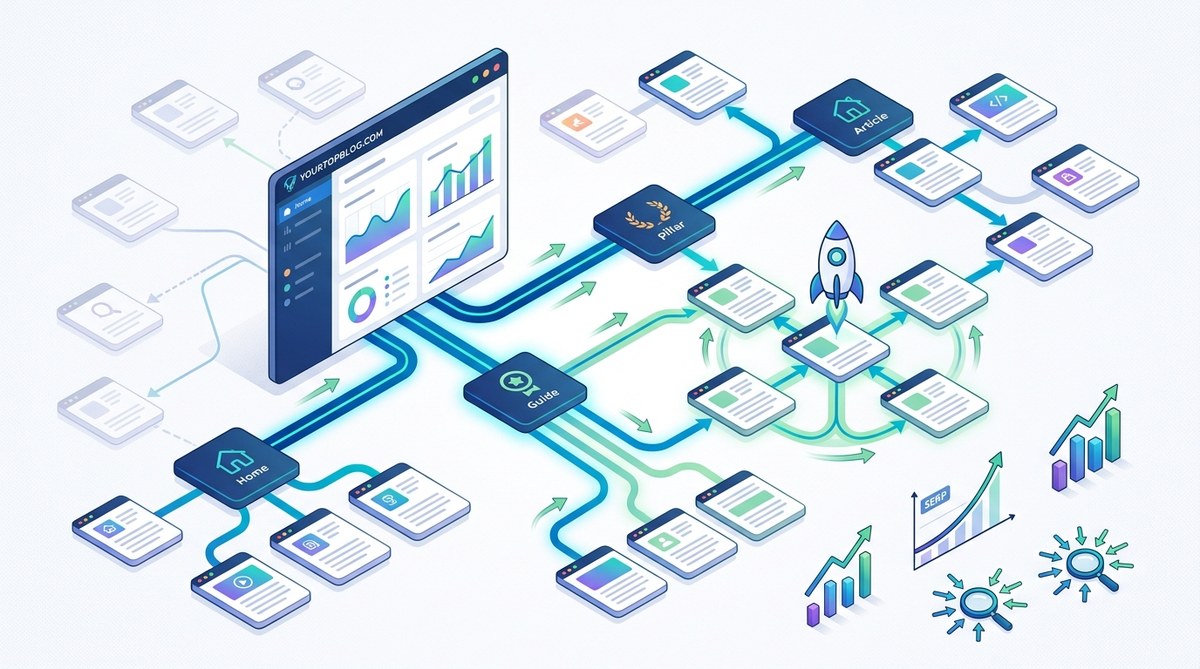
Most SEO practitioners obsess over backlinks while ignoring the web of connections already under their control. Your existing content holds untapped ranking power that costs nothing to activate. Internal linking strategy SEO transforms isolated blog posts into a cohesive authority engine that Google rewards with better visibility and higher positions.
Internal linking strategy SEO distributes PageRank across your site, establishes topical authority, improves crawlability, and boosts rankings without external backlinks. Strategic anchor text placement, logical site hierarchy, and consistent link depth create measurable traffic gains within weeks. Most sites waste 60% of their internal linking potential by leaving high-value pages orphaned or buried beyond three clicks from the homepage.
Why internal links matter more than you think
Search engines follow links to discover, crawl, and understand your content. Every internal link passes authority from one page to another. Pages with more internal links typically rank higher because Google interprets them as important resources worth promoting.
Your homepage naturally holds the most authority. When you link from it to a category page, you transfer some of that power. When that category page links to individual posts, the authority flows further. This cascading effect builds ranking potential across your entire site.
Most bloggers publish content and forget it. They never connect new posts to older ones. They never update cornerstone content with fresh links. This creates orphaned pages that Google rarely crawls and users never find.
A solid internal linking strategy SEO approach fixes this problem. It ensures every page receives link equity. It guides visitors toward conversion points. It signals which topics deserve ranking priority.
Building your site hierarchy foundation
Your site structure determines how easily search engines understand your content relationships. A flat hierarchy puts everything three clicks or less from the homepage. A deep hierarchy buries content six or seven levels down where crawlers rarely visit.
Start with these core layers:
- Homepage at the top
- Main category pages one click away
- Subcategory pages two clicks away
- Individual posts three clicks away
This structure makes sense to both humans and bots. Visitors find what they need fast. Crawlers index everything efficiently.
Category pages act as hubs. They should link to every post within that topic. They should also link to related categories. This creates a web of connections that reinforces topical relevance.
If you run a monetization blog, your categories might include AdSense optimization, affiliate marketing, SEO techniques, and traffic generation. Each hub page links to 10 or 20 posts within that niche. Each post links back to its hub and to 3 or 5 related posts.
The site structure blueprint that search engines and readers both love walks through this framework in detail with visual examples.
Choosing anchor text that ranks
Anchor text tells search engines what the linked page is about. Generic phrases like “click here” or “read more” waste ranking potential. Descriptive anchors like “AdSense CTR optimization tactics” send clear signals.
Use exact match anchors sparingly. If every link to your AdSense guide uses “AdSense optimization,” Google might flag it as manipulative. Mix in partial matches, branded terms, and natural variations.
Here are anchor text patterns that work:
- Exact match for 10% of links
- Partial match for 30% of links
- Branded or natural phrases for 40% of links
- Generic terms for 20% of links
Your anchor text should read naturally within the sentence. Forced insertions look spammy. Smooth integration feels helpful.
Bad example: “For more information about internal linking strategy SEO, click here.”
Good example: “Implementing a structured internal linking strategy fixes crawlability issues that keep pages from ranking.”
Distributing PageRank strategically
Not all pages deserve equal link equity. Your money pages need more internal links than your about page. Your cornerstone content deserves more authority than your random blog post from 2019.
Identify your top 10 revenue-driving pages. These might be product reviews, comparison guides, or tutorial series. Link to them frequently from related content. Include them in your navigation menu. Feature them in your sidebar.
Pages with high conversion rates but low traffic need more internal links. Pages with high traffic but low conversions might need better internal linking to guide visitors toward action.
Run a crawl using Screaming Frog or a similar tool. Sort pages by internal link count. Any important page with fewer than five internal links needs attention. Any thin content page with more than 20 internal links wastes authority.
Redistribute links to match your business priorities. Your complete on-page SEO checklist for bloggers in 2026 should receive more links than your cookie policy.
Creating contextual link opportunities
Contextual links within body content carry more weight than footer links or sidebar widgets. They appear natural. They provide genuine value to readers.
When you publish a new post, immediately identify three to five older posts it relates to. Add links from those older posts to your new one. This gives fresh content an instant authority boost.
When you update old content, add links to newer posts that expand on specific points. This keeps cornerstone content relevant and distributes authority to supporting articles.
Look for these contextual linking opportunities:
- Mentioning a specific tactic that you cover elsewhere
- Referencing data or case studies from another post
- Introducing a concept that needs deeper explanation
- Comparing two approaches you’ve written about separately
Every link should enhance the reader’s experience. If it feels forced or irrelevant, skip it.
Avoiding common internal linking mistakes
Many site owners sabotage their own SEO with poor internal linking practices. Here are the mistakes that hurt rankings most:
| Mistake | Why it hurts | How to fix it |
|---|---|---|
| Linking only to homepage | Wastes deep page authority | Link to relevant category and post pages |
| Using same anchor text repeatedly | Triggers over-optimization filters | Vary anchor text naturally |
| Burying links in footers only | Reduces crawl priority and equity | Add contextual body links |
| Ignoring orphaned pages | Leaves content undiscovered | Audit and connect isolated pages |
| Linking to low-value pages | Dilutes authority distribution | Prioritize money pages and hubs |
| Breaking links during redesigns | Creates 404 errors that waste equity | Implement 301 redirects |
Orphaned pages represent the biggest missed opportunity. These are posts with zero internal links pointing to them. Google might never find them. Visitors definitely won’t.
Run an orphan page report monthly. Connect every orphaned post to at least two related articles. Add them to relevant category pages. Feature them in roundup posts.
Broken internal links confuse crawlers and frustrate users. They signal neglect. Fix them immediately when you discover them.
Implementing topic clusters for authority
Topic clusters organize content around pillar pages. The pillar covers a broad subject comprehensively. Cluster posts address specific subtopics in detail. All cluster posts link to the pillar. The pillar links to all cluster posts.
This structure establishes topical authority. It tells Google you’ve covered a subject thoroughly. It helps you rank for competitive head terms and long-tail variations simultaneously.
For example, a pillar page on affiliate marketing might cover:
- Choosing profitable programs
- Writing converting reviews
- Disclosing relationships legally
- Building email funnels
- Tracking performance metrics
Each subtopic gets its own detailed post. Those posts link back to the pillar with relevant anchor text. The pillar links to each cluster post in a logical table of contents or throughout the body content.
Your how to write affiliate product reviews that convert without sounding salesy post would link to an affiliate marketing pillar. That pillar would link back to the review writing guide along with posts about 7 high-converting affiliate programs that actually pay bloggers in 2026 and why your affiliate links aren’t converting and 9 ways to fix it today.
Measuring internal linking performance
Track these metrics to gauge internal linking effectiveness:
- Average crawl depth for important pages
- Organic traffic to pages after adding internal links
- Keyword rankings for linked pages
- Click-through rates on internal links
- Pages per session and session duration
Google Search Console shows which pages Google crawls most frequently. Pages buried deep in your site structure get crawled less often. Adding internal links from high-authority pages increases crawl frequency.
Set up event tracking in Google Analytics to monitor internal link clicks. This reveals which links users actually follow. Remove links that nobody clicks. Strengthen links that drive engagement.
Compare keyword rankings before and after implementing internal linking changes. Most sites see measurable improvements within four to six weeks. Pages that gain 10 or more quality internal links often jump several positions.
“Internal linking is the most underutilized SEO tactic I see. Sites that master it consistently outrank competitors with stronger backlink profiles. The authority is already there. You just need to distribute it properly.” – Rand Fishkin, SEO expert
Scaling your internal linking process
Manual internal linking works for small sites. Once you pass 100 posts, you need systems.
Create a spreadsheet tracking:
- Post title and URL
- Target keyword
- Current internal link count
- Priority level (high, medium, low)
- Related posts to link from
- Last update date
When you publish new content, consult this spreadsheet. Identify five older posts that should link to your new piece. Add those links within 24 hours.
When you update old content, check the spreadsheet for newer posts that deserve links. Add three to five contextual links per update.
Set quarterly reminders to audit your top 20 pages. Ensure each has at least 10 internal links from relevant content. Refresh anchor text if it’s grown stale.
Some WordPress plugins automate parts of this process. They suggest relevant posts to link to while you write. They highlight orphaned pages. They track link counts per post.
Automation helps, but human judgment matters more. Plugins can’t determine which links genuinely help readers. They can’t craft natural anchor text. They can’t prioritize based on business goals.
Integrating internal links with content updates
Your older posts hold ranking potential you’re not using. Most of them need internal linking refreshes to compete.
Pick one high-traffic post per week. Read through it completely. Look for opportunities to link to newer content that expands on specific points. Look for outdated information you can update with fresh data and new links.
This serves multiple purposes:
- Freshens content signals for search engines
- Distributes authority to newer posts
- Improves user experience with current information
- Increases pages per session
A post from 2022 about keyword research might mention finding low-competition terms. You published a detailed guide on how to find low competition keywords that actually drive traffic in 2024. Add a contextual link from the old post to the new one.
This strategy compounds over time. Every updated post strengthens your internal linking web. Every new link passes authority. Every improved user experience signals quality to Google.
Connecting revenue streams through links
Your monetization pages need strategic internal linking. Whether you earn through ads, affiliates, or products, internal links guide visitors toward conversion points.
If you monetize with AdSense, link educational posts to optimization guides. A post about growing traffic should link to your guide on how I increased my AdSense CTR from 0.8% to 3.2% in 30 days.
If you promote affiliate products, link informational content to review posts. A post about email marketing basics should link to your review of email service providers.
If you sell courses or tools, link tutorial posts to product pages. A post about Pinterest traffic should link to your Pinterest course sales page.
This creates natural conversion funnels. Readers arrive through informational searches. They learn from your content. They click internal links to deeper resources. They eventually reach your monetization pages with high intent.
Don’t spam every post with sales links. Maintain an 80/20 ratio. Eighty percent of links should serve readers first. Twenty percent can guide toward revenue.
Leveraging breadcrumbs for structure
Breadcrumbs show the path from homepage to current page. They appear at the top of posts like this:
Home > SEO Techniques > Internal Linking Strategy
These navigational elements do three things:
- Help users understand site structure
- Provide additional internal links
- Send hierarchy signals to search engines
Every page should display breadcrumbs. They should link to each level in the path. They should use schema markup so Google can display them in search results.
Breadcrumbs with schema often appear as rich snippets. This increases click-through rates. It makes your site look more authoritative in search results.
Implement breadcrumbs through your theme or a plugin. Ensure they reflect your actual site structure. Test them with Google’s Rich Results Test tool.
Refreshing your linking strategy quarterly
Internal linking isn’t a one-time task. Your site grows. Your priorities shift. Your strategy should evolve.
Every three months, run these checks:
- Identify your top 10 traffic-driving pages
- Count internal links pointing to each
- Add links from related content if counts are low
- Remove links from irrelevant content
- Update anchor text to reflect current keywords
Your why your blog posts aren’t ranking and how to fix it guide might have been a priority in January. By April, your how I doubled my organic traffic in 90 days without building backlinks case study might deserve more internal links because it’s converting better.
Adjust your internal linking to match performance data. Pages that convert get more links. Pages that bounce get fewer links or better content improvements before link building.
Turning internal links into ranking gains
Internal linking strategy SEO delivers results when you treat it as an ongoing system, not a checkbox task.
Start with your site structure. Build clear hierarchies. Connect every page within three clicks. Create topic clusters around your most important subjects.
Add contextual links naturally. Vary your anchor text. Prioritize money pages and conversion content. Fix orphaned pages and broken links immediately.
Track performance monthly. Measure crawl depth, traffic changes, and ranking improvements. Adjust your strategy based on what’s working. Scale your process as your site grows.
Your existing content already holds the authority you need. Internal links simply redistribute it to where it matters most. Implement these tactics this week and you’ll see measurable ranking improvements within a month.