
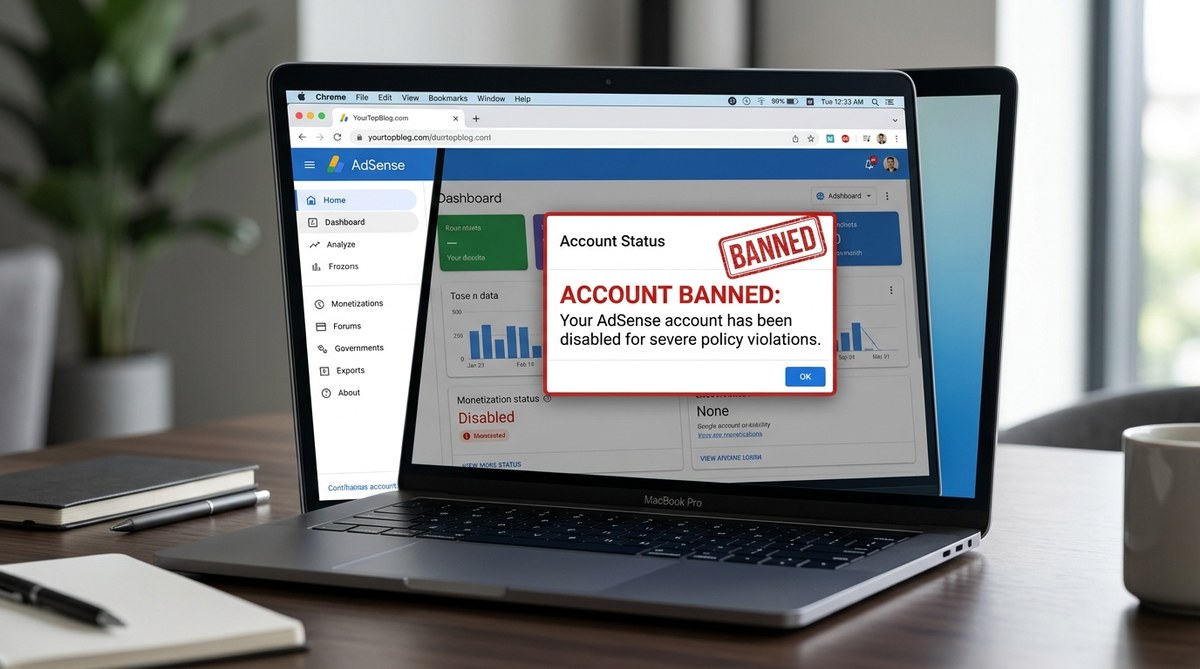
Getting that email from Google AdSense feels like a punch to the gut. One minute you’re checking your earnings, the next you’re staring at a suspension notice that threatens your entire income stream. I’ve talked to hundreds of bloggers who’ve been through this, and the panic is always the same.
Most AdSense bans stem from invalid click activity, policy violations around content, or improper ad placement. While appeals work in about 30% of cases, your best strategy combines understanding the exact violation, submitting a detailed appeal, and building alternative revenue streams that protect you from single-platform dependency. Recovery takes 2-6 months on average.
Why Google Bans AdSense Accounts Without Warning
Google’s automated systems scan millions of sites every day. They’re looking for patterns that suggest fraud, spam, or policy violations.
The algorithm doesn’t care about your intentions. It sees data points and makes decisions.
Here are the most common triggers:
- Invalid click activity from the same IP addresses
- Content that violates publisher policies (adult content, copyrighted material, dangerous products)
- Ad implementation that tricks users into clicking
- Traffic from bot networks or click farms
- Sites with insufficient original content
Google won’t always tell you the specific reason. Their emails are intentionally vague to prevent people from gaming the system.
That vagueness makes recovery harder. You’re essentially guessing at what went wrong.
The Three Types of AdSense Suspensions
Not all bans are created equal. Understanding which type you’re facing changes your approach.
Account Disabled: This is the harshest penalty. Your entire account is shut down across all sites. Google found something serious enough to ban you completely.
Site Disabled: Google removed one specific site from your account but left others active. This usually means the problem is isolated to that property.
Ad Serving Limited: Your account still works, but ads won’t show on some or all pages. This is often temporary while Google investigates.
The type of suspension appears in your AdSense dashboard and in the email notification. Check both sources because sometimes the dashboard has more detail.
| Suspension Type | Severity | Appeal Success Rate | Typical Resolution Time |
|---|---|---|---|
| Account Disabled | High | 25-30% | 4-8 weeks |
| Site Disabled | Medium | 40-50% | 2-4 weeks |
| Ad Serving Limited | Low | 60-70% | 1-2 weeks |
How to Appeal an AdSense Ban the Right Way
Most people write terrible appeals. They’re emotional, defensive, or don’t address the actual issue.
Your appeal needs to be clinical and specific.
Here’s the process that works:
-
Wait 24-48 hours before appealing. The initial panic leads to bad writing. Let yourself calm down first.
-
Review every page on your site. Look for policy violations you might have missed. Check ad placements, content quality, and user experience.
-
Document everything you find and fix. Take screenshots showing before and after states. Create a spreadsheet listing every change.
-
Write a structured appeal that includes these elements: acknowledgment of the violation (if you found one), specific steps you took to fix it, and preventive measures you’ve implemented.
-
Submit through the official appeal form in your AdSense dashboard. Don’t email support directly or use social media.
-
Follow up once per week if you don’t hear back within 7 days. Be polite but persistent.
The appeals that work best admit fault (when appropriate), show concrete fixes, and demonstrate understanding of why the policy exists. Generic “I didn’t do anything wrong” appeals get rejected 95% of the time.
If you’re dealing with invalid click activity, you need to prove the clicks weren’t intentional. Install security plugins, show server logs, and explain any unusual traffic patterns. Google wants to see that you’re actively preventing fraud.
For content violations, remove or rewrite the problematic pages. If you had copyrighted images, replace them. If your content was thin, add substantial value. Show the work in your appeal.
Common Mistakes That Get Appeals Rejected
I’ve reviewed hundreds of rejected appeals. The same errors appear over and over.
Creating a new account: This violates Google’s terms and gets both accounts banned permanently. Don’t do it.
Blaming Google: Your appeal isn’t the place to argue about fairness. Stick to facts and solutions.
Ignoring the real problem: If Google says you have invalid clicks but you only talk about content quality, your appeal fails.
Being vague about fixes: “I improved my site” means nothing. “I removed 47 pages with duplicate content and rewrote 23 product descriptions to include original analysis” shows real work.
Appealing multiple times with the same message: If your first appeal gets rejected, your second one needs new information. Don’t just resubmit the same text.
The appeals team sees thousands of requests every week. Make yours stand out by being thorough, honest, and specific.
What to Do While Waiting for Appeal Results
Sitting around hoping Google reinstates you is a terrible strategy. Use this time productively.
First, diversify your income immediately. Relying on a single ad network was always risky. Now you know why.
Consider these alternatives to AdSense:
- Media.net for contextual ads similar to AdSense
- Ezoic for sites with 10,000+ monthly visits
- Mediavine or AdThrive if you meet their traffic requirements
- Direct ad sales to companies in your niche
- Affiliate programs that align with your content
Second, audit your entire monetization strategy. If losing AdSense killed your income, your business model was too fragile.
Build multiple revenue streams. Combine ads with affiliate marketing, digital products, sponsored content, and email monetization. That way, losing any single source hurts but doesn’t destroy you.
Third, improve your content quality. Whether Google reinstates you or not, better content drives more traffic and converts better for any monetization method.
Focus on these improvements:
- Add original research, case studies, or data
- Improve page speed and mobile experience
- Update old posts with current information
- Remove thin or duplicate content
- Add more detailed explanations and examples
If you’re struggling with traffic growth, use this downtime to fix those issues too.
Building a Ban-Proof Monetization Strategy
The real lesson from an AdSense ban isn’t about following rules better. It’s about reducing platform risk.
Any company can change their terms, ban your account, or shut down completely. Building your income on someone else’s platform is inherently risky.
Here’s how to protect yourself:
Own your audience: Build an email list. Those subscribers belong to you, not to Google or any other platform. Email monetization often outperforms display ads anyway.
Diversify traffic sources: Don’t rely only on Google search. Use Pinterest, email, social media, and other channels. If one source dries up, others keep you alive.
Create multiple income streams: Aim for at least three different monetization methods. If one fails, you still have two others running.
Build real assets: Digital products, courses, and membership sites give you more control than advertising. You set the prices and rules.
Test new platforms early: Don’t wait until you need an alternative to find one. Test different ad networks, affiliate programs, and monetization methods while things are going well.
The bloggers who survive long-term aren’t the ones who never face problems. They’re the ones who build systems that can handle problems without collapsing.
When to Give Up on AdSense and Move On
Sometimes the appeal won’t work. Google’s decision is final, and they won’t budge.
That’s frustrating, but it’s not the end of your blogging business.
Many publishers make more money after leaving AdSense. The platform pays relatively low CPMs compared to premium networks. If you have decent traffic, you probably qualify for better options.
Ezoic accepts sites with 10,000 monthly visits. Mediavine wants 50,000 sessions. AdThrive requires 100,000 pageviews. These networks typically pay 2-4 times what AdSense does.
Even if you don’t meet those thresholds yet, focusing on alternative passive income streams often generates better returns than display ads.
Consider this scenario: You were making $500 per month from AdSense with 30,000 monthly visitors. That’s roughly $16.67 per thousand visitors.
With the same traffic, you could potentially earn:
- $800-1,200 from a premium ad network
- $600-1,000 from well-placed affiliate links
- $400-800 from a small digital product
- $300-600 from sponsored posts
Stack two or three of those, and you’re making significantly more than AdSense ever paid.
The ban might have done you a favor by forcing you to build a better business model.
Preventing Future Account Suspensions
If Google does reinstate your account, treat it like a second chance. One more violation likely means a permanent ban.
Implement these safeguards:
Monitor your traffic sources daily: Set up Google Analytics alerts for unusual spikes. Investigate any traffic that looks suspicious.
Educate anyone who has site access: If you have writers, VAs, or partners with login credentials, make sure they understand AdSense policies.
Review ad placements monthly: Google’s policies evolve. What was acceptable last year might violate current rules.
Keep content clean: Avoid borderline topics that might trigger policy violations. If you’re unsure whether something is allowed, assume it isn’t.
Document everything: Keep records of your traffic sources, content changes, and site modifications. If you need to appeal again, you’ll have data ready.
Use ad placement tools carefully: Some WordPress themes and plugins place ads in ways that violate policies. Test thoroughly and check Google’s guidelines.
Many bloggers also avoid common AdSense mistakes that reduce earnings even when they don’t trigger bans.
Alternative Paths Forward After a Ban
Your adsense account banned status doesn’t define your future as a publisher. It’s a setback, not a death sentence.
Some of the most successful bloggers I know got banned from AdSense early in their careers. That forced them to build better businesses.
They focused on creating products their audience actually wanted. They built email lists and nurtured relationships. They partnered with brands for sponsored content. They tested affiliate offers until they found winners.
All of those strategies generate more revenue per visitor than display ads ever could.
The key is treating this as a business problem to solve, not a catastrophe to survive. You have skills, traffic, and an audience. Those assets work with or without AdSense.
Start by picking one alternative monetization method and implementing it properly. Don’t try to add five new income streams at once. Master one, then add another.
Track your numbers carefully. Measure revenue per visitor, conversion rates, and time invested. Double down on what works and cut what doesn’t.
Moving Forward Stronger Than Before
Getting your adsense account banned hurts. There’s no sugarcoating that reality.
But publishers who treat this as a wake-up call often build more sustainable, profitable businesses than they had before. They diversify income, reduce platform risk, and create real value instead of just chasing ad impressions.
Your next steps are clear. Submit a thoughtful appeal if you haven’t already. Start testing alternative monetization methods today. Build systems that can survive platform changes and policy updates.
The bloggers who thrive long-term aren’t the ones who never face setbacks. They’re the ones who adapt, learn, and come back stronger. Your ban might be the push you needed to build something better than you originally planned.