
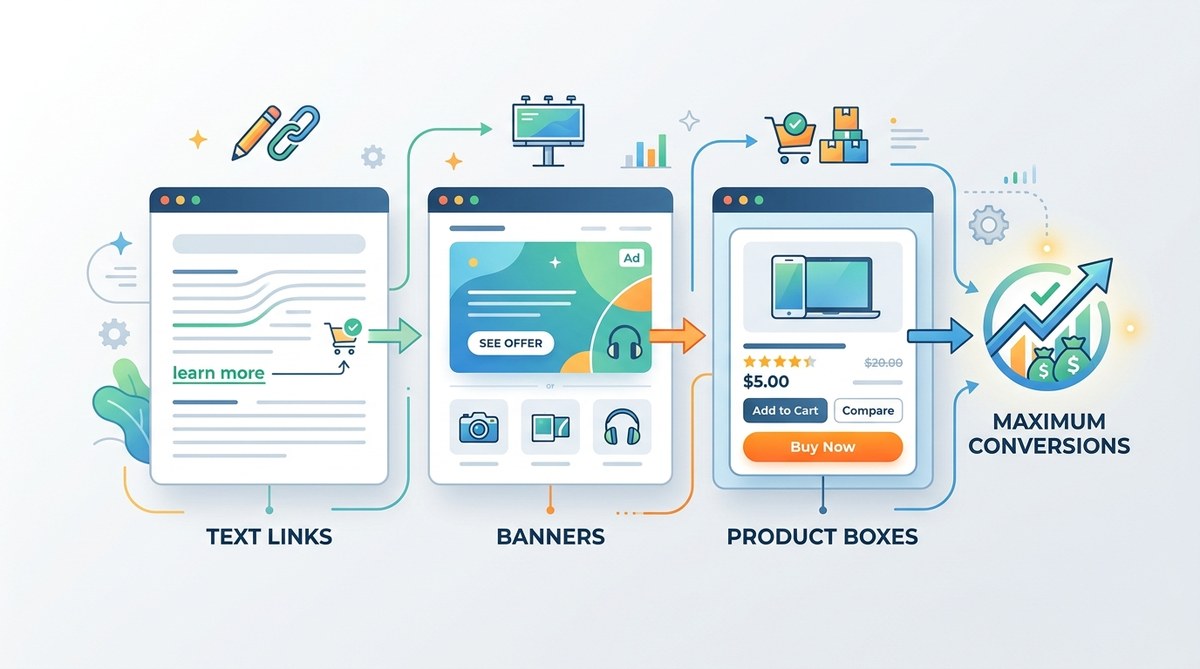
Starting a website or blog is exciting, but turning visitors into engaged customers or subscribers can feel tricky. Choosing the right types of links and ads plays a big role in maximizing conversions. Whether you’re aiming for more email signups, product sales, or ad revenue, understanding when and how to use text links, banners, or product boxes can make a real difference.
Effective conversion strategies depend on choosing the right link or ad format. Text links work well for subtlety, banners grab attention, and product boxes highlight offers. Matching the format to your goal and audience boosts results significantly.
Understanding the differences between text links, banners, and product boxes is the first step to creating a balanced, conversion-friendly website. Each format has its strengths and ideal use cases. The key is knowing when to deploy each for the best results.
Why Choosing the Right Format Matters
Not all links or ads are created equal. Using the wrong type can lead to lower click-through rates and missed opportunities. For example, banners are eye-catching but can be ignored if they don’t match the content or look out of place. On the other hand, subtle text links are less intrusive and can be effective in content-rich pages.
Matching your goals with the right format can help you:
- Drive more email signups
- Increase product sales
- Boost ad revenue
- Improve user experience and trust
Let’s examine each format and how to leverage them for maximum effect.
When to Use Text Links
Text links are simple, often embedded within your content or navigation menus. They blend naturally with your text, making them less intrusive and more relevant.
Best scenarios for text links
- Within blog posts or articles: Linking to related products or resources without disrupting the flow.
- Call-to-action (CTA) placements: Subtle prompts like “Download our free guide” or “Join our newsletter” work well as text links.
- Navigation menus: For internal pages to guide visitors smoothly.
Advantages of text links
- Less distracting and more seamless.
- Easier to optimize for SEO.
- Can be embedded naturally into your content.
Practical process for using text links
- Identify key points or keywords in your content.
- Embed relevant links to your products, courses, or other pages.
- Use descriptive, natural anchor text that matches the linked content.
- Track performance to see which links generate clicks.
When Banners Shine
Banners are visual ads that grab attention. They come in various sizes and styles, from static images to animated ads.
Best scenarios for banners
- Homepage hero sections: Highlighting your main offer or newest product.
- Sidebar ads: Promoting related products or upcoming events.
- Special promotions: Flash sales or seasonal offers benefit from eye-catching banners.
Advantages of banners
- Visual appeal increases click rates.
- Great for branding and awareness.
- Can be designed to match your site’s style.
How to deploy banners effectively
- Use high-quality images and clear messaging.
- Place banners where visitors naturally look, like headers or sidebars.
- Test different sizes and designs to see what performs best.
- Limit the number of banners to avoid clutter.
Harnessing Product Boxes for Conversions
Product boxes are designed to showcase a specific product or offer prominently. They often include images, descriptions, and clear CTAs.
Best scenarios for product boxes
- Product pages: To highlight features and benefits.
- Landing pages: To focus visitor attention on a single offer.
- Email campaigns: To showcase featured products or courses.
Advantages of product boxes
- Visually highlight your offers.
- Provide detailed information to persuade visitors.
- Encourage quick decision-making with clear CTAs.
Tips for creating effective product boxes
- Use compelling images and concise descriptions.
- Include a strong CTA like “Buy now” or “Get your free trial.”
- Place product boxes where visitors are ready to convert.
- Use social proof or reviews to build trust.
Practical Steps to Optimize Your Link and Ad Usage
To make the most of your website monetization efforts, follow these steps:
-
Assess your goals
Define whether you want more signups, sales, or ad revenue. -
Match formats to content types
Use text links within blog content, banners for visibility spots, and product boxes for detailed offers. -
Test and refine
Regularly analyze performance metrics and tweak placements, designs, and copy. -
Balance subtlety and visibility
Use subtle text links for content flow and eye-catching banners or boxes for promotions. -
Avoid common mistakes
Overloading pages with banners can cause ad fatigue. Ignoring the importance of placement reduces click rates.
Techniques versus mistakes
| Techniques | Mistakes |
|---|---|
| Embedding descriptive anchor text | Using generic “Click here” links |
| Placing banners where they fit naturally | Overcrowding pages with too many banners |
| Using high-quality images for product boxes | Ignoring mobile responsiveness |
| Testing different formats regularly | Neglecting tracking and analytics |
“The secret to high conversions is matching the right format to your audience’s expectations and your website’s layout. Don’t be afraid to experiment and analyze results.” — Conversion expert
6 Strategies for effective use
- Use text links for subtle endorsements within your content.
- Reserve banners for high-visibility spots like headers or footers.
- Design product boxes to be visually appealing and informative.
- Combine formats for layered effects, like a banner with embedded product boxes.
- Regularly review your analytics to identify what works best.
- Keep user experience in mind, avoiding clutter and distraction.
How to Avoid Common Pitfalls
Misusing link and ad formats can hurt your site’s credibility and conversions. Some frequent mistakes include:
- Placing too many banners, which can overwhelm visitors.
- Using low-quality images or vague CTAs in product boxes.
- Ignoring mobile responsiveness, leading to poor performance on phones.
- Failing to track and analyze click data.
- Embedding links that are not relevant or appear spammy.
By understanding these pitfalls, you can craft a more effective strategy that aligns with your audience’s preferences.
A Mix of Formats for Maximum Impact
No single format works best for every situation. Combining text links, banners, and product boxes creates a natural flow that guides visitors toward your goals.
- Use text links to provide contextually relevant pathways.
- Place banners where they can draw attention without disrupting reading.
- Highlight product boxes on pages where you want visitors to take action.
This layered approach improves user experience and increases the likelihood of conversions.
Final Tips to Boost Your Conversion Rate
- Be subtle but strategic with your link placements.
- Design banners and product boxes to match your site’s style.
- Test different formats and placements regularly.
- Track performance metrics like click-through and conversion rates.
- Keep your audience’s needs and preferences at the forefront.
By applying these principles, you will create a harmonious balance that encourages visitors to take action.
Linking It All Together for Better Results
Choosing between text links, banners, and product boxes is not about replacing one with the other. It’s about understanding when and where each format delivers the best impact. Combining these formats smartly can lead to higher engagement, more signups, and increased sales.
Remember, the goal is to guide visitors naturally through your content, offering the right prompts at the right time. Testing and refining your approach will help you discover what resonates best with your audience.
Your Next Step Toward Higher Conversions
Start by reviewing your current link and ad placements. Identify opportunities to incorporate more relevant, well-designed formats. Focus on matching each format to your specific goals and audience expectations.
With patience and ongoing optimization, you’ll see your conversion rates improve steadily. Keep experimenting, analyzing, and adjusting — success is often in the details.
By understanding the strengths of text links, banners, and product boxes, you can craft a conversion strategy that feels natural and effective. Each format has its place, and the best results come from combining them thoughtfully. Take action today, and watch your website’s performance grow.