
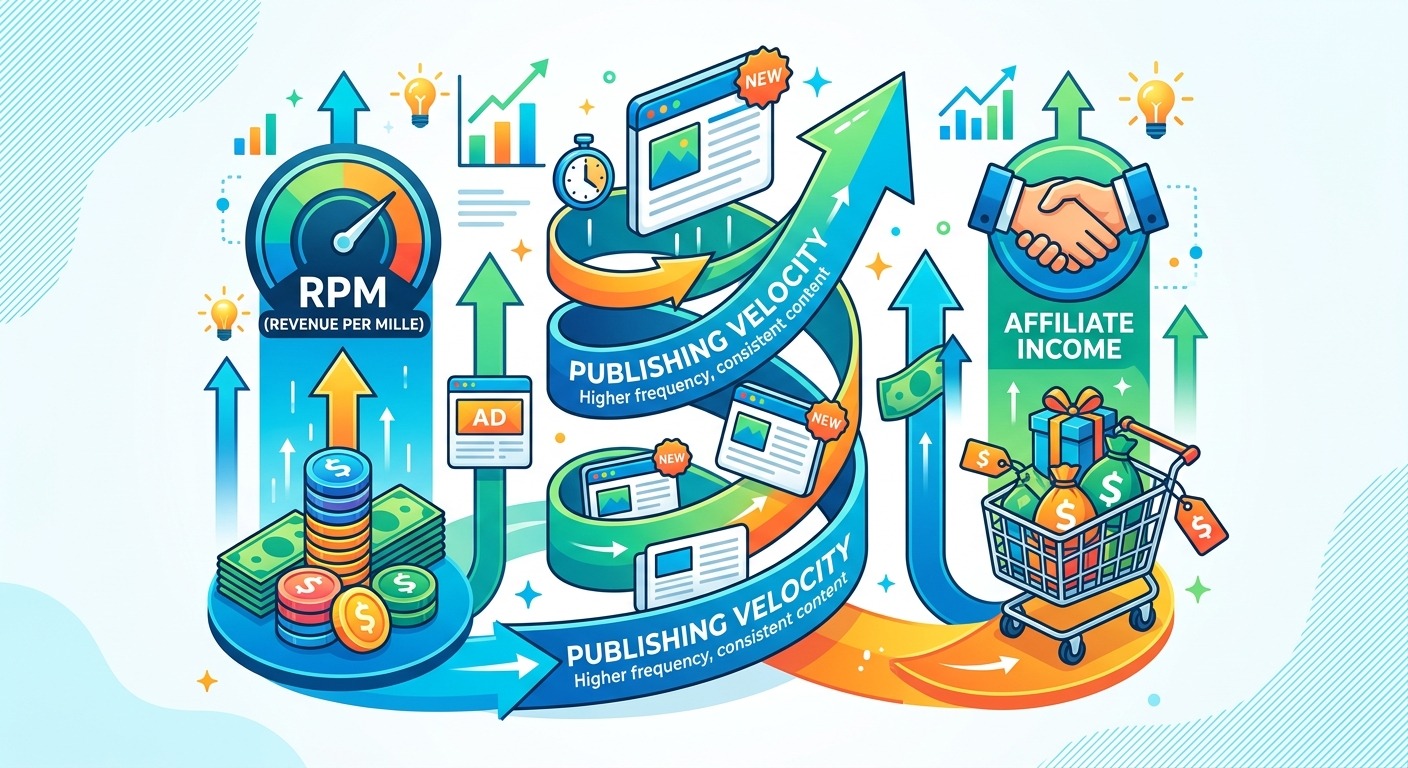
Most bloggers treat their income problem like a conversion problem. They move ad units around, A/B test affiliate link placement, and wonder why their RPM barely budges. The real bottleneck is usually sitting somewhere else entirely: the number of indexed posts bringing in traffic in the first place.
- Every new post you publish is a separate ad inventory unit and affiliate entry point that can rank independently.
- A higher total of indexed posts raises your site’s overall RPM by attracting more valuable, niche-matched traffic.
- A repeatable writing system is what separates bloggers who scale their output from those who burn out at twenty posts.
The Metric Most Bloggers Get Wrong About RPM
RPM stands for revenue per mille, meaning revenue per 1,000 pageviews. It’s calculated by dividing your total estimated earnings by your total pageviews, then multiplying by 1,000. The number looks like a fixed characteristic of your site, but it isn’t. It shifts based on the type of traffic your content attracts.
Here’s where publishing volume becomes the hidden variable. A blog with 200 posts covering a specific niche consistently surfaces higher-intent readers than a blog with 30 posts spread across random topics. Higher-intent readers are more valuable to advertisers. That value shows up in your RPM. The more posts you have targeting specific queries, the more your audience skews toward people advertisers are willing to pay premium rates to reach.
This is backed by how cost per mille advertising actually works: ad networks price inventory dynamically based on audience signals. Niche depth signals quality to algorithms. More posts mean more depth, which attracts higher-paying ad categories over time.
How Content Volume Compounds Organic Sessions
Think of each published post as a separate asset. Once it’s indexed and ranking, it generates sessions without you doing anything else. A blogger with 50 posts might get 10,000 monthly sessions. A blogger with 200 posts on a coherent topic might get 80,000, not because each post performs four times better, but because more posts create more entry points, and those entry points feed each other through internal links.
That compounding effect is what makes publishing cadence such a powerful lever. A blogger posting twice a week builds a library of 100 posts in a year. A blogger posting twice a month builds 24. At the end of that year, the first blogger has roughly four times the organic surface area for search engines to index, four times the ad inventory, and four times the affiliate link placements that can rank independently.
The compounding doesn’t stop there. As a site’s post count grows, Google begins recognizing it as an authority on the topic. Topical authority improves rankings across the board, including for older posts that were previously stuck on page two or three. The benefit isn’t just additive. It accelerates.
Publishing Cadence and Its Direct Connection to RPM Growth
Higher publishing velocity does something subtle that most bloggers miss: it improves the quality of your traffic mix. When you publish consistently within a niche, you attract readers who are genuinely interested in that topic. These readers tend to visit multiple posts per session, which increases pageviews per visit. That drives RPM up without you touching a single ad unit.
Some benchmarks to keep in mind as you evaluate your own output:
- Blogs publishing four or more posts per week often report RPM increases of 30 to 60 percent within 12 months, assuming topical consistency is maintained.
- Sites with 150 or more indexed posts in a focused niche tend to attract higher-tier advertisers through programmatic networks, which raises the floor on what any given 1,000 pageviews is worth.
- Affiliate income correlates strongly with the number of review-style or comparison posts that rank, since those pages attract buyers-in-mode readers rather than curiosity browsers.
These aren’t guarantees. Niche, keyword difficulty, and site age all factor in. But they give you a useful baseline for calibrating whether your current publishing pace is working against you.
Why Affiliate Income Is a Surface Area Problem
Affiliate marketers often spend enormous energy optimizing a handful of posts: tweaking call-to-action language, moving buttons above the fold, testing link colors. These efforts yield marginal gains. The bigger win comes from having more posts that can each rank for different buyer-intent queries and send traffic to affiliate offers independently.
A single affiliate post might rank for one or two keywords and convert at a rate of two to three percent. A blog with forty affiliate-focused posts can rank for dozens of buyer-intent queries simultaneously. Each post converts independently. Total affiliate income scales with the number of ranking entry points, not just the conversion rate of any one page.
This is why post count is a more durable advantage than link placement optimization. You can keep adjusting placements on your best-performing post forever, but you’ll eventually hit a ceiling. Publishing more posts removes that ceiling entirely.
Building a Repeatable Writing System That Sustains the Pace
Telling bloggers to publish more is easy. Making it sustainable is the hard part. Most bloggers who attempt to increase their publishing cadence hit a wall within six to eight weeks. They run out of ideas, their quality drops, or the time commitment becomes unmanageable alongside other responsibilities.
The fix isn’t discipline. It’s architecture. A repeatable writing system means having a content pipeline that removes decision-making overhead from the actual writing. You know what you’re writing next before you sit down. You have templates for different post types. You batch research separately from drafting. You never start a session staring at a blank page.
Focusing on writing productivity as an operational discipline, rather than a personality trait, is what allows bloggers to sustain a high publishing pace without burning out. The goal is to make showing up to write feel mechanical, not heroic. You’re executing a queue you built earlier in the week during a dedicated planning block, not making creative decisions under pressure.
Once the system is in place, the pace becomes self-sustaining. That shift in mindset is what separates bloggers who publish 200 posts in a year from those who struggle to hit 50.
Common Signs Your Publishing Pace Is Holding Back Your Income
Not sure if your current output is the bottleneck? There are a few patterns that show up consistently in blogs that are leaving money on the table through underproduction:
- Your top five posts drive more than 70 percent of your total traffic, with a long tail of posts getting almost no sessions at all.
- Your affiliate income fluctuates wildly month to month, suggesting it’s concentrated in one or two posts rather than distributed across a stable portfolio of ranking content.
- Your RPM hasn’t moved significantly in six months despite testing new ad placements, which points to a traffic quality issue rather than a placement issue.
If any of those describe your blog, adding more posts is likely to move the needle faster than further optimization of what you already have.
The Compound Interest of a Larger Content Library
The bloggers who scale their income the fastest aren’t necessarily the best writers. They’re often the most consistent publishers. They understood early that each post is an asset that pays dividends indefinitely, and that the total number of assets in their portfolio is the biggest driver of long-term income.
RPM growth, affiliate income, and organic traffic all share a common root: indexed post count across a coherent topic cluster. Optimizing ad placements or tweaking affiliate link positions has a ceiling. Building out a content library does not. The gap between a blog earning $200 a month and one earning $2,000 is rarely about how smart the monetization setup is. It’s almost always about the difference in total content output and how consistently it was produced.
Start tracking your publishing velocity the same way you track your RPM. Set a weekly post target. Build the system that makes hitting it repeatable. Then watch what happens to your earnings as the compound interest of content volume starts working in your favor.