

You’ve been writing about midnight diaper changes and toddler tantrums for months. Your traffic is growing. Your email list is slowly building. But your bank account? Still waiting for that first real paycheck.
The good news is that parenting blogs can generate serious income. I’ve watched dozens of parent bloggers turn naptime writing sessions into five-figure monthly earnings. The path isn’t always obvious, but it’s absolutely possible.
Parenting blogs make money through display ads, affiliate marketing, sponsored content, digital products, and coaching services. Success requires consistent traffic growth, strategic content planning, and diversified revenue streams. Most profitable parent bloggers combine three to five income sources and focus on building email lists alongside organic search traffic for sustainable long-term earnings.
Understanding the revenue potential for parent bloggers
Parent bloggers earn anywhere from $100 to $50,000 per month. The range is massive because income depends on traffic volume, monetization methods, and niche focus.
A parenting blog with 25,000 monthly visitors can generate $500 to $2,000 through display ads alone. Add affiliate commissions and sponsored posts, and that same traffic level can produce $3,000 to $5,000 monthly.
The real money comes when you stack multiple revenue streams. Display ads provide baseline income. Affiliate links add commission potential. Digital products create scalable profit. Sponsored content brings premium rates for established blogs.
Here’s what different traffic levels typically generate:
| Monthly Visitors | Display Ad Revenue | Total Potential Income |
|---|---|---|
| 10,000 | $200 to $400 | $500 to $1,500 |
| 25,000 | $500 to $1,000 | $1,500 to $4,000 |
| 50,000 | $1,000 to $2,500 | $3,000 to $8,000 |
| 100,000 | $2,500 to $6,000 | $7,000 to $15,000 |
These numbers assume you’re using premium ad networks and have implemented basic affiliate strategies. Your actual earnings will vary based on niche, audience engagement, and monetization sophistication.
Building traffic before monetization
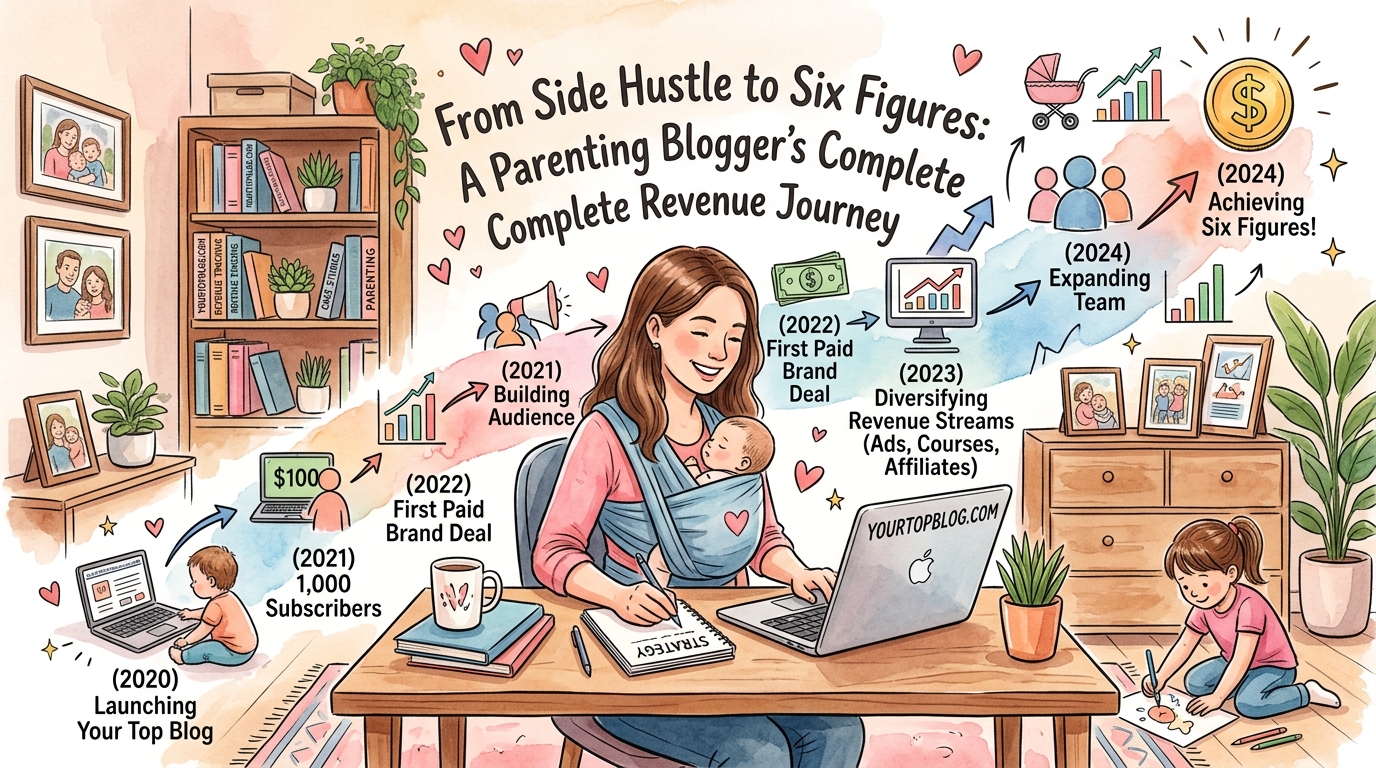
You need readers before you can earn money. Most ad networks require at least 10,000 monthly sessions. Affiliate programs work better with engaged audiences. Sponsors want proof of influence.
Start by publishing helpful content consistently. Two to three posts per week works better than sporadic bursts of ten articles followed by silence.
Focus on answering specific questions parents actually search for. “How to get baby to sleep through the night” performs better than “My thoughts on motherhood.” Finding low competition keywords that actually drive traffic makes a huge difference in how fast you grow.
Build your email list from day one. Every visitor who subscribes gives you a direct communication channel that isn’t dependent on search engine algorithm changes. Building an email list that drives repeat traffic creates a foundation for all your future monetization efforts.
Pinterest drives massive traffic for parenting content. Create vertical pins for every article. Join group boards in your niche. Schedule pins consistently throughout the week.
Facebook groups provide another traffic source. Answer questions genuinely. Share your expertise without being pushy. Include your blog link in your profile so interested parents can find your content naturally.
The biggest mistake new parent bloggers make is trying to monetize before they have enough traffic. Build your audience first. Revenue follows readers, not the other way around.
Display advertising as your foundation income
Display ads are the easiest way to start earning from your parenting blog. You place ad code on your site. Networks show relevant ads to your visitors. You earn money based on impressions and clicks.
Google AdSense is the starting point for most bloggers. Getting approved for Google AdSense even as a new blogger requires quality content and consistent traffic, but the barrier to entry is lower than premium networks.
AdSense typically pays $3 to $8 per 1,000 page views for parenting content. That’s enough to cover hosting costs and maybe a coffee habit while you grow.
Premium ad networks pay significantly more. Mediavine requires 50,000 sessions per month. AdThrive wants 100,000 page views. Both pay $15 to $30 per 1,000 page views, sometimes higher for parenting niches.
The jump from AdSense to Mediavine can triple your ad revenue overnight with the same traffic. That’s why focusing on traffic growth matters so much in your first year.
Common mistakes kill your ad earnings potential. AdSense mistakes that are costing you thousands every month shows you what to avoid as you implement display advertising.
Ad placement affects earnings dramatically. Ads above the fold, within content, and at the end of articles perform best. Too many ads hurt user experience and actually decrease total revenue.
Mobile optimization matters more for parenting blogs than almost any other niche. Parents browse on phones while feeding babies, waiting at soccer practice, or hiding in the bathroom for five minutes of peace. If your site loads slowly on mobile, you’re losing both traffic and ad revenue.
Affiliate marketing for parenting products
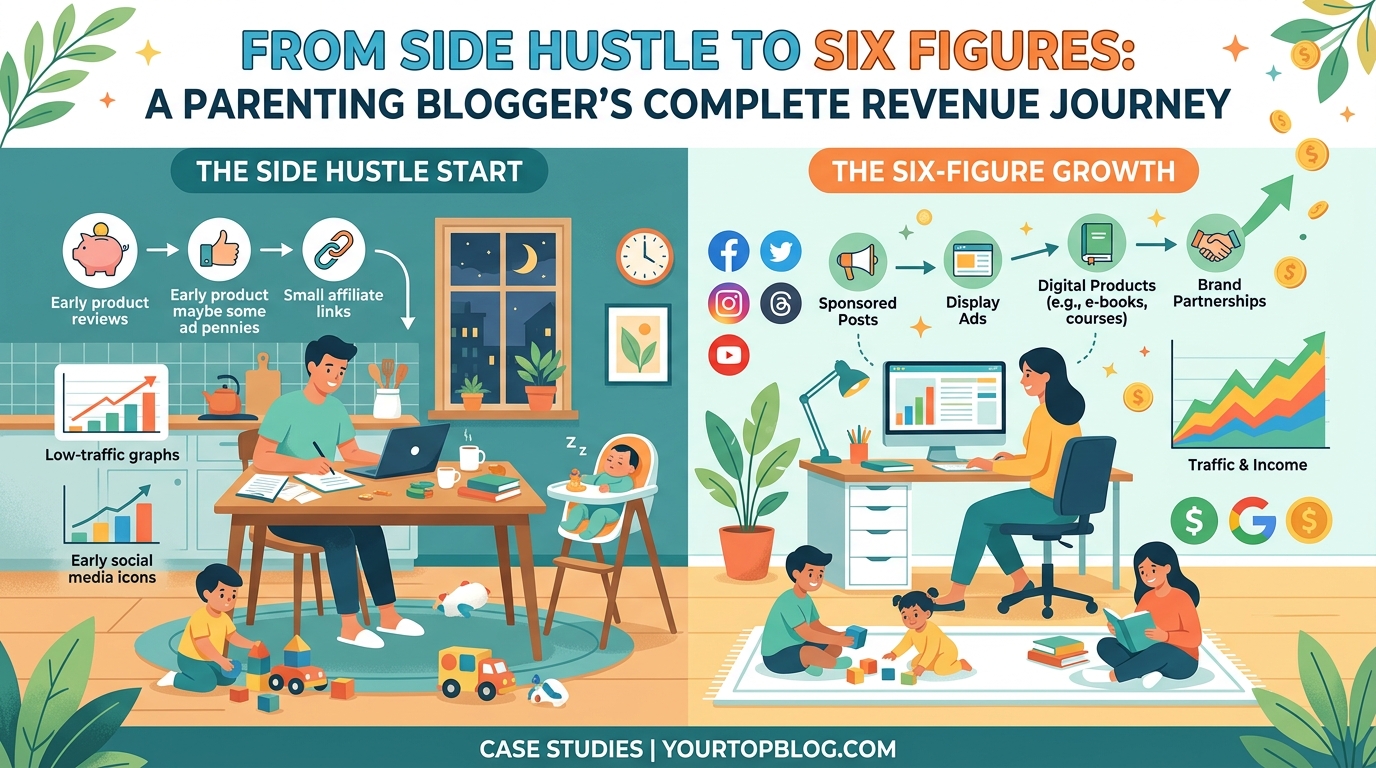
Affiliate commissions can match or exceed your ad revenue with the right strategy. You recommend products you actually use. Parents click your affiliate links. You earn a percentage of each sale.
Amazon Associates is the obvious starting point. The commission rates are low (1% to 4% for most categories), but parents already trust Amazon and buy there regularly.
Link to specific products within your content naturally. If you’re writing about potty training, mention the potty seat that worked for your toddler. Include your affiliate link. Parents who trust your advice will click and buy.
Higher-paying affiliate programs exist beyond Amazon. High-converting affiliate programs that actually pay bloggers in 2024 includes several options perfect for parenting content.
Target Corporation’s affiliate program pays 1% to 8% depending on the category. Not amazing, but Target appeals to your exact audience.
ShareASale and CJ Affiliate host dozens of parenting-related programs. Baby gear companies, toy manufacturers, and children’s clothing brands all run affiliate programs through these networks.
Digital product affiliates pay much higher commissions. Parenting courses pay 30% to 50%. Ebooks about sleep training or picky eating often offer 40% commissions. The sales volume is lower than physical products, but the profit per sale is substantially higher.
Create comparison posts and gift guides. “Best strollers for city living” or “Gift ideas for two-year-olds” naturally include multiple affiliate links and perform well in search results year after year.
Seasonal content with affiliate links generates passive income. Your “Toddler Halloween costume ideas” post from 2022 still earns commissions every October. Your “Back to school lunch box ideas” keeps paying you each August.
Disclose your affiliate relationships clearly. The FTC requires it. Your readers deserve transparency. A simple statement like “This post contains affiliate links, which means I earn a small commission if you purchase through my links at no extra cost to you” handles the legal requirement and maintains trust.
Sponsored content and brand partnerships
Brands pay parent bloggers to create content featuring their products. A sponsored post typically pays $200 to $5,000 depending on your traffic, engagement, and niche authority.
Start pitching sponsors once you hit 10,000 monthly page views. Some brands work with smaller blogs if your audience engagement is strong and your niche aligns perfectly with their product.
Create a media kit showing your traffic stats, audience demographics, social media following, and engagement rates. Include your email open rates if they’re strong. Brands want proof their investment will reach real parents who might buy their products.
Pitch brands directly rather than waiting for them to find you. Send personalized emails explaining why their product fits your audience. Include specific content ideas. Show you’ve actually researched their brand and understand their marketing goals.
Join influencer networks like ACTIVATE, AspireIQ, or Clever. These platforms connect bloggers with brands looking for sponsored content creators. The pay is often lower than direct partnerships, but the opportunities are more consistent.
Price your sponsored posts based on your traffic and effort required. A simple product mention in a roundup post might be $200. A dedicated review with custom photography and social media promotion could be $1,000 to $3,000.
Always disclose sponsored content clearly at the top of the post. “This post is sponsored by [Brand Name]” maintains trust with your readers and complies with FTC guidelines.
Choose sponsors carefully. Your readers trust your recommendations. Promoting products you wouldn’t actually use destroys that trust fast. One bad sponsored post can undo months of credibility building.
Creating and selling digital products
Digital products scale infinitely. Create once, sell forever. No inventory. No shipping. Pure profit after the initial creation time investment.
Ebooks work well for parenting blogs. “30 Toddler Lunch Ideas Your Picky Eater Will Actually Eat” or “The Overwhelmed Mom’s Guide to Simplifying Bedtime” solve specific problems parents face daily.
Price ebooks between $7 and $27. Lower prices generate more sales volume. Higher prices position you as an expert and attract serious buyers willing to invest in solutions.
Printables are incredibly popular with parent audiences. Chore charts, potty training trackers, meal planning templates, and kids’ activity sheets sell consistently. Create them once in Canva. Sell them through your blog or Etsy.
Bundle multiple printables together for higher perceived value. A “Complete Potty Training Kit” with charts, reward stickers, and parent guides sells for $15 to $25. Individual printables might only sell for $3 to $5.
Online courses command premium prices. A comprehensive course on “Getting Your Baby to Sleep Through the Night” can sell for $97 to $297. The creation effort is substantial, but the profit potential is massive.
Email courses work as both lead magnets and paid products. A free 5-day email course builds your list and establishes authority. A paid 30-day course with detailed lessons, worksheets, and community access can generate serious income.
Use your blog content to validate product ideas. Which posts get the most traffic? What questions appear repeatedly in comments? What problems do your readers struggle with most? Create products that solve those specific issues.
Passive income streams every blogger should add beyond AdSense covers additional product options that work well for parent bloggers.
Coaching and consulting services
One-on-one coaching pays premium rates. Parents struggling with specific challenges will pay $50 to $200 per hour for expert guidance.
Position yourself as the solution to a specific problem. Sleep consultant. Potty training coach. Picky eating specialist. Specific expertise commands higher rates than general parenting advice.
Start with one-off sessions before creating ongoing programs. A single 60-minute call is less intimidating for both you and potential clients. You can test your offering and refine your approach.
Package your knowledge into group programs. A 6-week group coaching program on “Ending Mealtime Battles” can include weekly video calls, a private Facebook group, and worksheets. Charge $297 to $497 per participant. Ten participants generate $2,970 to $4,970 for six weeks of work.
Your blog content demonstrates your expertise and attracts coaching clients. Every helpful article builds trust. Readers who get value from your free content become paying clients when they need deeper support.
Create a simple application process. A brief questionnaire helps you understand potential clients’ situations and ensures you can actually help them. It also filters out people who aren’t serious about investing in solutions.
Limit your coaching availability. Scarcity increases perceived value. “I only take five new clients per month” sounds more valuable than “I’m available whenever you want to book.”
Membership sites and subscription content
Recurring revenue provides financial stability that one-time sales can’t match. A membership site with 100 paying members at $15 monthly generates $1,500 every single month.
Offer exclusive content members can’t get anywhere else. Advanced tutorials, printable libraries, monthly challenges, or live Q&A sessions give people reasons to stay subscribed.
Patreon works well for parent bloggers who create regular content. Offer different tiers. $5 monthly might include bonus blog posts. $15 monthly adds printables and resources. $30 monthly includes group coaching calls.
Private communities add tremendous value. A Facebook group or Discord server where paying members can ask questions, share struggles, and support each other creates connection that keeps people subscribed.
Start small with membership offerings. You don’t need 50 different benefits. Three to five valuable perks are enough if they genuinely help your members.
Price your membership based on the value you provide and your audience’s budget. Parent audiences often have tight budgets but will pay for solutions that save time or reduce stress.
Retention matters more than acquisition for membership income. A member who stays for 12 months at $15 monthly is worth $180. Focus on keeping current members happy rather than constantly chasing new ones.
Building your monetization timeline
Month 1 to 3: Focus entirely on content creation and traffic growth. Publish consistently. Optimize for search engines. Why your blog posts aren’t ranking and how to fix it helps you avoid common mistakes that slow growth.
Month 4 to 6: Apply for Google AdSense once you hit their minimum requirements. Add Amazon affiliate links to relevant posts. Start building your email list aggressively.
Month 7 to 9: Upgrade to a premium ad network if you’ve reached their traffic thresholds. Join additional affiliate programs beyond Amazon. Create your first digital product.
Month 10 to 12: Pitch your first sponsored posts. Launch your digital product. Test coaching or consulting services.
This timeline assumes steady effort and reasonable growth. Some bloggers move faster. Others take longer. The sequence matters more than the exact timing.
Don’t try to implement everything at once. Stacking multiple revenue models without overwhelming your readers explains how to add income streams strategically.
Common mistakes that kill parenting blog income
Monetizing too early scares away readers before you’ve built trust. Nobody wants to read a blog that’s clearly just trying to sell them stuff.
Ignoring SEO means you’re dependent on social media for traffic. Social platforms change algorithms constantly. Search traffic is more stable and predictable. The complete on-page SEO checklist for bloggers in 2024 covers the basics every parent blogger needs.
Promoting products you don’t actually use destroys credibility fast. Your readers can tell when you’re being genuine versus when you’re just chasing a commission.
Neglecting your email list means you’re building your business on rented land. Social media platforms can ban you. Search engines can change their algorithms. Your email list is yours forever.
Giving up too soon is the most common mistake. Most parenting blogs take 6 to 12 months to generate meaningful income. The bloggers who succeed are simply the ones who keep publishing when results feel slow.
Here’s what to avoid versus what actually works:
| Mistake | Better Approach |
|---|---|
| Adding ads with 500 monthly visitors | Wait until 10,000+ sessions |
| Promoting every affiliate offer you find | Only recommend products you’ve used |
| Writing whatever you feel like | Research what parents actually search for |
| Posting once per month inconsistently | Publish 2-3 helpful posts weekly |
| Ignoring email list building | Offer a valuable freebie on every post |
Technical foundations that support monetization
Your hosting matters more than you think. Slow sites lose visitors and hurt search rankings. Complete website hosting guide for bloggers who want maximum uptime and speed helps you choose the right option.
WordPress gives you the most monetization flexibility. Should you build your site on WordPress, Wix, or custom code compares your options if you’re still deciding.
Essential plugins make monetization easier. Ad inserters help you place ads strategically. Affiliate link managers cloak ugly URLs and track clicks. Email opt-in tools capture subscribers. Essential WordPress plugins every new monetized blog needs installed covers the must-haves.
Mobile optimization isn’t optional. Over 70% of parenting blog traffic comes from phones. If your site doesn’t load fast and look good on mobile, you’re losing money every single day.
Learning from successful parent bloggers
Real examples prove what’s possible. One mom started a blog about toddler activities during her maternity leave. Eighteen months later, she was earning $4,000 monthly from ads, affiliates, and her printable shop.
Another parent blogger focused on baby sleep training. She built her traffic to 30,000 monthly visitors, then launched a $197 course. Her first launch generated $15,000 in sales. Now she runs the course quarterly and earns $40,000 to $60,000 annually just from that one product.
A dad blogger wrote about positive parenting techniques. His traffic grew slowly, but his engagement was incredible. Brands started reaching out for sponsored posts. He now charges $2,000 per sponsored article and publishes two per month.
These bloggers didn’t have special advantages. They identified problems parents face. They created helpful content. They built trust over time. They monetized strategically.
The $10K per month blog blueprint for diversifying from zero to full-time income breaks down exactly how bloggers in various niches reach five-figure monthly earnings.
Tracking your progress and adjusting strategy
Install Google Analytics from day one. Track which posts generate the most traffic. Notice which topics resonate most with your audience. Double down on what works.
Monitor your income sources monthly. Calculate your earnings per 1,000 visitors for each revenue stream. If sponsored posts earn more per visitor than affiliate links, prioritize sponsor relationships.
Test different approaches systematically. Try different affiliate programs. Experiment with product pricing. Test various email subject lines. Small improvements compound over time.
Set realistic milestones:
- First $100 month
- First $500 month
- Cover your expenses (hosting, tools, etc.)
- Replace one monthly bill (car payment, groceries, etc.)
- Match your previous job income
Celebrate each milestone. Building a profitable parenting blog takes time and persistence. Recognizing progress keeps you motivated during slower months.
Diversification protects your income
Never rely on a single revenue source. Ad networks can ban accounts. Affiliate programs can shut down. Sponsors can disappear.
Aim for at least three income streams once you’re established. Display ads provide baseline income. Affiliates add variable commission potential. Digital products or services create high-margin opportunities.
Why 90% of bloggers fail at diversification and how to be in the 10% explains the strategic approach that actually works.
Balance passive and active income. Display ads and affiliate links generate money while you sleep. Coaching and sponsored posts require active effort but pay premium rates.
The most stable parenting blog income comes from multiple sources working together. Your ads pay your bills. Your affiliates fund business growth. Your products and services create wealth.
Your parenting blog can absolutely generate real income
Thousands of stay-at-home parents are earning substantial money from their blogs right now. They started exactly where you are, wondering if this whole blogging thing could actually work.
The path is clear. Build helpful content. Grow your traffic. Implement monetization strategically. Stay consistent when results feel slow.
Your parenting experience has value. The solutions you’ve figured out can help other parents. The products you’ve tested can save other families time and money. The strategies you’ve learned can reduce stress for overwhelmed moms and dads.
Start with one income stream. Master it. Add another. Keep building. Your first $100 month will feel amazing. Your first $1,000 month will feel surreal. Your first $5,000 month will change how you think about what’s possible.
The parenting blog you start today could be supporting your family a year from now. But only if you actually start.