
You’ve built an email list. Subscribers open your messages. They click through to your content. But you’re still relying on banner ads that pay pennies per thousand impressions.
There’s a better way.
Email lists represent direct access to engaged readers who already trust you. That relationship is worth far more than passive ad revenue. The challenge is converting that trust into sustainable income without alienating your audience.
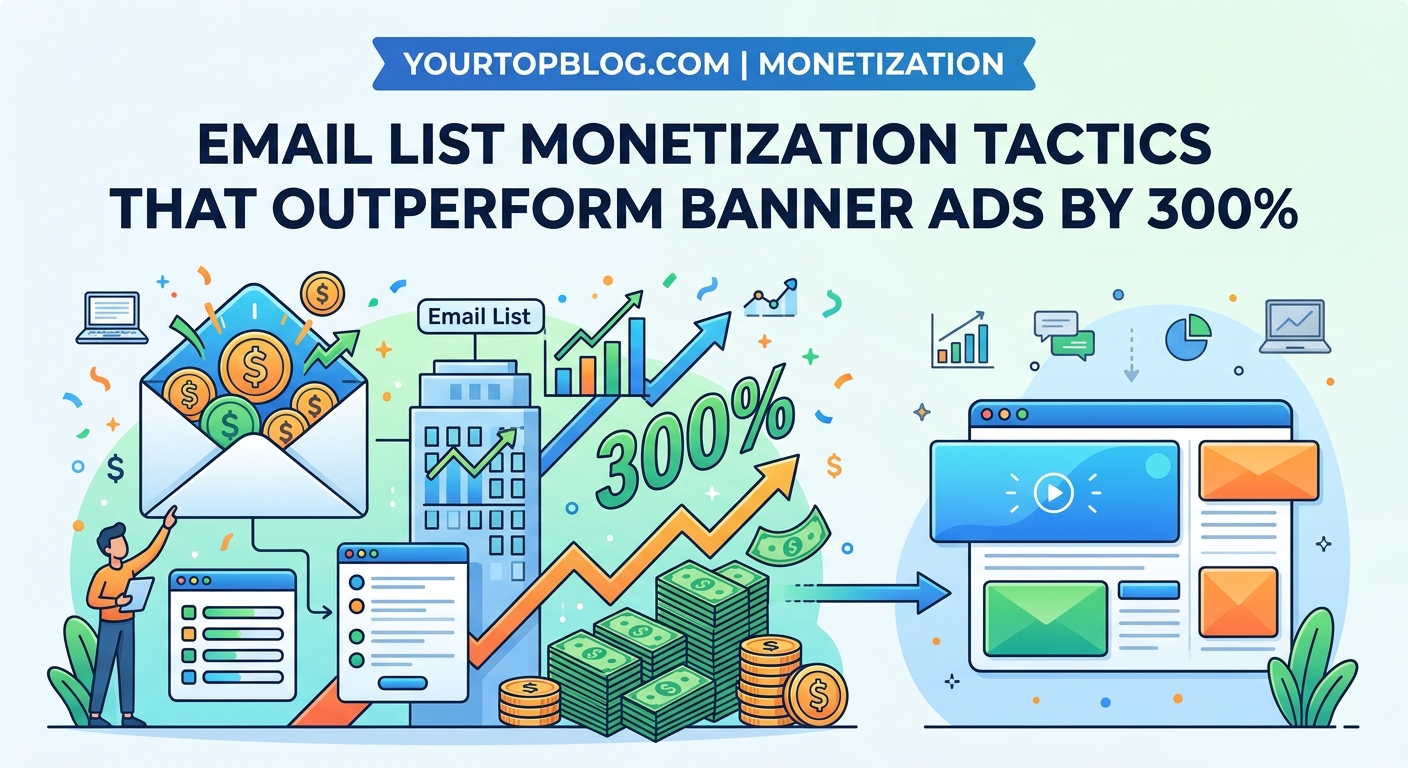
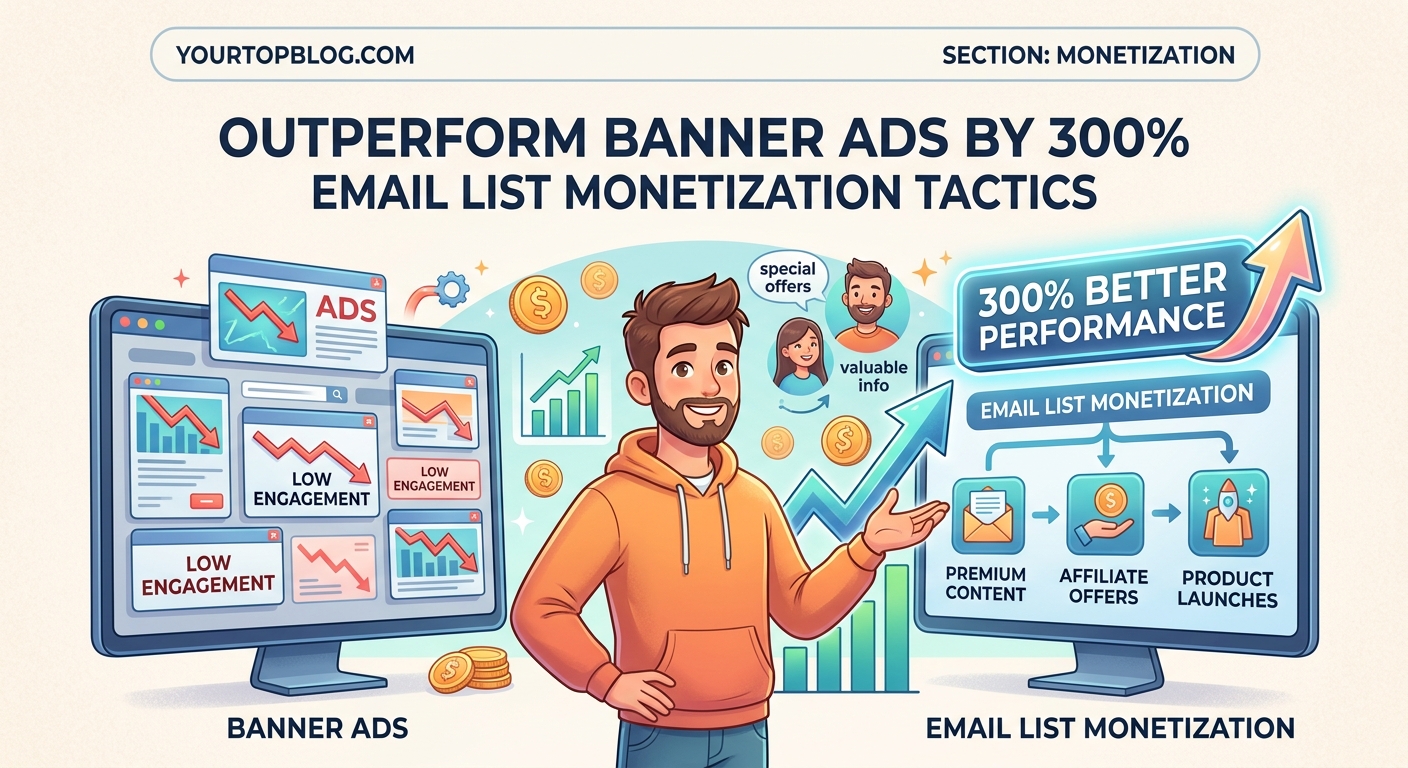
Email list monetization strategies include sponsored newsletters, premium subscriptions, digital products, affiliate partnerships, and service offerings. Publishers who combine three or more revenue streams from their lists typically earn 300% more than those relying solely on display advertising. Success requires segmentation, value delivery, and strategic promotion timing that respects subscriber trust while maximizing lifetime value.
Why Email Lists Outperform Traditional Ad Revenue
Display advertising pays based on impressions and clicks. Most bloggers earn between $5 and $25 per thousand pageviews from ad networks.
Email subscribers represent a different economic model entirely.
When someone gives you their email address, they’re granting permission for ongoing communication. You control the message, timing, and call to action. No algorithm decides whether your content reaches them.
This direct relationship creates multiple monetization opportunities that compound over time. A subscriber who purchases a $47 digital product generates more revenue than 2,000 ad impressions. That same subscriber might buy again, recommend your products, or upgrade to premium offerings.
The math changes completely when you own the distribution channel.
Publishers who master email monetization often reduce their dependence on search traffic and social algorithms. Traffic fluctuations matter less when you can generate revenue on demand by emailing your list. This stability allows for better business planning and sustainable growth.
Sponsored Newsletter Placements That Maintain Trust
Brands pay premium rates to access engaged email audiences. Sponsored placements in newsletters can command $25 to $100 per thousand subscribers, depending on your niche and engagement metrics.
The key is maintaining editorial integrity while delivering value to sponsors.
Start by identifying brands your audience already uses and trusts. Reach out with your media kit showing open rates, click rates, and subscriber demographics. Propose a test campaign with clear performance metrics.
Structure sponsored content as valuable information rather than hard sales pitches. A cooking newsletter might feature a sponsored segment on time-saving kitchen tools, with genuine recommendations and honest usage notes. Readers appreciate helpful suggestions from trusted sources.
Set clear boundaries about frequency. Most successful newsletter publishers limit sponsored content to one placement per week or less. Overwhelming subscribers with promotions destroys the trust that makes sponsorships valuable in the first place.
Track performance meticulously. Sponsors care about clicks, conversions, and return on investment. Publishers who provide detailed analytics command higher rates and secure long-term partnerships.
Premium Subscription Models That Deliver Ongoing Value
Converting free subscribers into paying members creates recurring revenue that compounds monthly.
The subscription model works when you offer clear value that free content doesn’t provide. This might include:
- Advanced tutorials and case studies
- Exclusive tools and templates
- Direct access through community forums
- Early access to new content
- Ad-free experiences
- Personalized consulting or feedback
Price points vary widely by niche. Business and marketing newsletters often charge $10 to $50 monthly. Specialized technical content can command $100+ for professional audiences.
Start with a small pilot group before launching publicly. Invite your most engaged subscribers to a founding member program at a discounted rate. Use their feedback to refine your offering before scaling.
The conversion rate from free to paid typically ranges from 1% to 5% for well-executed subscription models. A list of 10,000 subscribers converting at 2% generates 200 paying members. At $20 monthly, that’s $4,000 in recurring revenue.
Retention matters more than acquisition for subscription businesses. Focus on consistent value delivery, regular communication with members, and continuous improvement based on feedback. Publishers who maintain monthly churn below 5% build sustainable subscription income.
Digital Products Tailored to Subscriber Needs
Your email list tells you exactly what products to create. Every question, reply, and click reveals what your audience wants to learn or accomplish.
Digital products monetize this knowledge at scale.
Ebooks, courses, templates, and software tools all work when they solve specific problems your subscribers face. The advantage of digital products is unlimited inventory and high profit margins.
Here’s a proven product development process:
- Survey your list about their biggest challenges in your niche
- Analyze which topics generate the highest engagement in your emails
- Create a minimum viable product addressing the top problem
- Offer it first to a small segment at an early-bird price
- Refine based on feedback and testimonials
- Launch to your full list with social proof from early buyers
Price products based on the value delivered, not the time invested. A template that saves someone 10 hours of work is easily worth $97, even if you spent only 5 hours creating it.
Launch sequences convert better than single promotional emails. A typical sequence includes:
- Problem awareness email highlighting the challenge
- Solution introduction explaining your approach
- Social proof sharing results from beta users
- Urgency message with a limited-time offer
- Final reminder before the deadline
Publishers who build product catalogs create multiple entry points for monetization. Someone might start with a $27 ebook, later purchase a $197 course, and eventually invest in $997 consulting. Each product serves different budget levels and commitment stages.
Strategic Affiliate Recommendations Based on Usage
Affiliate marketing through email works differently than on-page promotion. You’re recommending products directly to people who trust your judgment.
This responsibility requires careful product selection and transparent disclosure.
Only promote products you’ve personally used and would recommend regardless of commission. Your reputation with subscribers is worth more than any single affiliate payment.
Segment your list based on interests and behavior before sending affiliate promotions. Someone who clicked on SEO content probably cares about keyword tools. They likely don’t care about email service provider recommendations. Targeted promotions convert better and annoy fewer people.
The most effective affiliate emails tell stories about how you use the product. Share specific results, workflow improvements, or problems solved. Include screenshots, metrics, or before-and-after comparisons when possible.
Timing matters significantly. Promote tax software in January, not July. Recommend blogging tools when someone joins your list, not six months later. Context and relevance determine conversion rates.
Track which affiliate offers resonate with different segments. Some audiences respond to software tools, others prefer courses or services. Double down on what works for your specific subscribers rather than promoting everything available.
Many successful publishers earn more from a few well-chosen affiliate partnerships than from dozens of scattered promotions. High-converting affiliate programs that align with your audience’s needs generate consistent revenue without constant promotion.
Service Offerings That Scale With Your Expertise
Consulting, coaching, and done-for-you services represent the highest revenue per transaction for most email-based businesses.
The challenge is balancing service delivery with scalability.
Start by offering limited consulting spots to test demand and refine your process. Email your list with specific outcomes you help clients achieve. Price based on the value of those outcomes, not hourly rates.
As demand grows, create leverage through group programs, recorded training, or templated service packages. A publisher might start with one-on-one consulting at $500 per hour, then develop a group coaching program at $2,000 per member, and eventually create a self-service course at $497.
Each tier serves different buyers while protecting your time.
Application funnels work better than open enrollment for premium services. Require potential clients to complete a questionnaire before booking. This filters out poor fits and provides information to personalize your pitch.
Service-based monetization works especially well in professional niches. Business strategy, marketing implementation, technical training, and specialized consulting all command premium rates from email audiences.
The key is positioning services as investments with measurable returns rather than expenses. A $5,000 consulting package that helps a client generate $50,000 in new revenue is an obvious decision.
Segmentation Techniques That Increase Revenue Per Subscriber
Treating all subscribers the same leaves money on the table. Different people have different needs, budgets, and interests.
Segmentation allows personalized monetization.
Basic segmentation starts with behavior tracking. Tag subscribers based on:
- Which lead magnet they downloaded
- What content they click in your emails
- Which products they’ve purchased
- How long they’ve been subscribed
- Their engagement level (opens and clicks)
Advanced segmentation includes demographic data, stated preferences, and predictive modeling based on similar subscriber behavior.
Send different offers to different segments. New subscribers might receive foundational products. Engaged long-term subscribers see advanced offerings. Previous buyers get upgrade opportunities or complementary products.
This table shows how segmentation affects monetization:
| Segment Type | Offer Strategy | Typical Conversion | Revenue Impact |
|---|---|---|---|
| New subscribers (0-30 days) | Entry-level products, free resources | 1-3% | Builds trust, low immediate revenue |
| Engaged readers (opens >50%) | Mid-tier products, affiliate tools | 3-7% | Primary revenue driver |
| Previous buyers | Upsells, premium offerings | 10-20% | Highest revenue per subscriber |
| Inactive (no opens 90+ days) | Re-engagement or removal | <1% | Clean list, improve deliverability |
Segmentation also improves deliverability. Sending only to engaged subscribers keeps open rates high, which signals email providers that your messages are wanted. Better inbox placement means more revenue from every campaign.
Avoiding Common Monetization Mistakes
Most email publishers make predictable errors that cap their revenue potential.
Here are the mistakes that cost the most:
Promoting too frequently. Subscribers who receive daily sales pitches unsubscribe or tune out. Most successful publishers maintain a 4:1 ratio of valuable content to promotional messages.
Ignoring mobile optimization. Over 60% of emails are opened on mobile devices. Long paragraphs, tiny fonts, and complex layouts kill conversions. Keep emails scannable with short paragraphs, clear headlines, and prominent call-to-action buttons.
Failing to test. Subject lines, send times, offer positioning, and price points all affect revenue. Publishers who systematically test variables earn significantly more than those who guess.
Neglecting list hygiene. Inactive subscribers drag down engagement metrics and increase costs. Remove people who haven’t opened in 6-12 months after a re-engagement campaign.
Copying competitors blindly. What works for someone else’s audience might fail with yours. Test strategies, but adapt them to your specific subscriber base.
Underpricing products. New publishers often charge too little, fearing price resistance. Most audiences care more about value and results than absolute price. A $497 product that solves a major problem sells better than a $47 product that seems too cheap to work.
Ignoring the unsubscribe button. People who don’t want your emails won’t buy anyway. Make unsubscribing easy to maintain a healthy, engaged list.
“The biggest mistake I see is publishers treating their email list like a ATM machine. You can’t just show up when you need money. Consistent value delivery builds the relationship that makes monetization possible.” – Email marketing consultant with 15+ years experience
Building Multiple Revenue Streams Without Overwhelming Readers
The most successful email publishers combine several monetization methods strategically.
This diversification protects against platform changes, market shifts, and seasonal fluctuations.
Start with one primary revenue stream and master it before adding others. A publisher might begin with affiliate recommendations, then add digital products, and later introduce premium subscriptions.
Each addition should enhance rather than distract from existing offerings. A course creator might add templates as a lower-priced entry point and consulting as a premium upsell. All three serve the same audience with different commitment levels.
Stacking multiple revenue models requires careful planning to avoid subscriber fatigue. Space major launches at least 30 days apart. Rotate which products you mention in regular content emails. Use segmentation to ensure subscribers only see relevant offers.
Track revenue contribution by source monthly. Many publishers discover that 80% of their income comes from 20% of their monetization methods. Double down on what works rather than spreading effort equally across everything.
The goal is building passive income streams that generate revenue with minimal ongoing effort. Digital products, affiliate partnerships, and subscription income all fit this model once established.
Measuring What Matters for Email Revenue
Revenue per subscriber is the metric that matters most for email monetization.
Calculate it by dividing total email-generated revenue by your list size. A publisher earning $10,000 monthly from a 5,000-subscriber list has a revenue per subscriber of $2.00.
This metric reveals whether your list is growing more valuable over time. Increasing revenue per subscriber means your monetization is improving even if list growth slows.
Other critical metrics include:
- Email open rate: Indicates subject line effectiveness and sender reputation (aim for 20%+ in most niches)
- Click-through rate: Shows content relevance and call-to-action clarity (2-5% is typical)
- Conversion rate: Measures how many clickers become buyers (1-10% depending on offer and audience)
- Unsubscribe rate: Signals content-audience fit (keep below 0.5% per send)
- Revenue per email sent: Total revenue divided by number of promotional emails (helps optimize frequency)
Track these metrics in a simple spreadsheet or dashboard. Monthly review reveals trends and opportunities for improvement.
A/B testing accelerates optimization. Test one variable at a time:
- Subject lines (curiosity vs. clarity)
- Send times (morning vs. evening, weekday vs. weekend)
- Email length (short vs. detailed)
- Call-to-action placement (top vs. bottom)
- Offer framing (discount vs. value-add)
Even small improvements compound significantly. Increasing conversion rate from 2% to 3% means 50% more revenue from the same traffic.
Growing Your List While Maintaining Quality
Monetization potential scales with list size, but only if you maintain subscriber quality.
A list of 1,000 engaged subscribers generates more revenue than 10,000 disinterested people who never open your emails.
Focus on attracting your ideal subscribers rather than maximizing numbers. Building an email list that drives revenue starts with clear positioning and valuable lead magnets.
Your lead magnet should attract people likely to buy your products eventually. A free checklist about “cutting grocery costs” attracts different people than “investing in dividend stocks,” even though both relate to personal finance.
Match your lead magnet to your monetization strategy.
Traffic sources matter significantly. Subscribers from organic search typically engage better than social media traffic because they’re actively seeking solutions. Growing blog traffic creates a steady stream of qualified subscribers.
Use content upgrades to boost conversion rates. Offer bonus resources related to specific articles. Someone reading about email subject lines might download a template pack. This relevance creates more engaged subscribers.
Set expectations clearly from the first email. Tell new subscribers what to expect, how often you’ll email, and what value you provide. This transparency reduces early unsubscribes and builds trust.
Welcome sequences should deliver immediate value while introducing your monetization offers naturally. A typical sequence includes:
- Immediate delivery of the promised lead magnet
- Introduction to your story and mission
- Your best free content and resources
- Soft introduction to paid offerings
- Invitation to reply with questions or challenges
This sequence builds the relationship that makes later monetization possible.
Turning Subscribers Into Long-Term Revenue Partners
The most profitable email subscribers aren’t one-time buyers. They’re repeat customers who purchase multiple products over months or years.
Maximizing lifetime value requires thinking beyond individual transactions.
Create product ecosystems where each purchase leads naturally to the next. A subscriber might start with a $27 ebook, realize they need implementation help, and purchase a $297 course. Later, they might join a $97/month membership for ongoing support.
Each step solves a deeper level of the same core problem.
Communicate regularly even when you’re not selling. Publishers who only email during launches train subscribers to ignore their messages. Consistent value delivery through educational content, case studies, and useful resources keeps your audience engaged.
Ask for feedback and actually use it. Survey subscribers about what they’re struggling with, what content they want, and what products would help them most. This input guides product development and shows you’re listening.
Celebrate subscriber wins publicly (with permission). Share success stories, case studies, and testimonials. This social proof encourages others while recognizing the people who trust you enough to take action.
Consider creating a community around your email list. A private forum, Facebook group, or Discord server gives subscribers a place to connect, share experiences, and support each other. Communities increase retention and create additional monetization opportunities.
The relationship you build through email becomes a business asset that appreciates over time. Subscribers who trust you will follow you into new niches, buy new products, and recommend you to others.
Making Email Revenue Sustainable and Scalable
Email list monetization isn’t about tricks or hacks. It’s about building genuine relationships and delivering consistent value.
The strategies that work long-term are the same ones that feel right ethically. Recommend products you believe in. Create offerings that genuinely help people. Price based on value delivered. Respect your subscribers’ time and attention.
Start with one monetization method that aligns with your strengths and audience needs. Master it completely before adding complexity. Track your results, test improvements, and scale what works.
Your email list represents the most valuable asset in your online business. Treat it accordingly. Every subscriber is a real person who chose to hear from you. Honor that trust while building revenue streams that support your work.
The publishers earning serious income from their lists aren’t necessarily the ones with the biggest audiences. They’re the ones who understand their subscribers deeply, deliver value consistently, and monetize strategically without compromising relationships.
You can do the same. Start today by choosing one strategy from this guide and implementing it completely. Your email list is waiting to become your most profitable asset.