

You’ve picked a product to promote. You’ve joined the affiliate program. Now comes the hard part: writing a review that actually makes money without turning readers away.
Most affiliate reviews fail because they sound like sales pitches. Readers can smell desperation from a mile away. They close the tab and never come back.
The good news? You can write reviews that convert without sounding like a used car salesman. It takes a different approach, one that puts honesty first and sales second.
Successful affiliate product reviews balance genuine experience with strategic persuasion. Focus on solving specific problems, share real results with proof, acknowledge limitations honestly, and guide readers to informed decisions. This approach builds trust that converts better than any hard sell, creating long-term revenue from loyal audiences who value your recommendations.
Why most affiliate reviews feel sleazy
Walk into any niche and you’ll find dozens of cookie-cutter reviews. They all follow the same tired formula.
Big headline promising the world. Five-star rating for everything. Zero criticism. Aggressive call-to-action buttons every three sentences.
Readers aren’t stupid. They know you get paid when they click. The question is whether you’ve earned their trust enough for them to care.
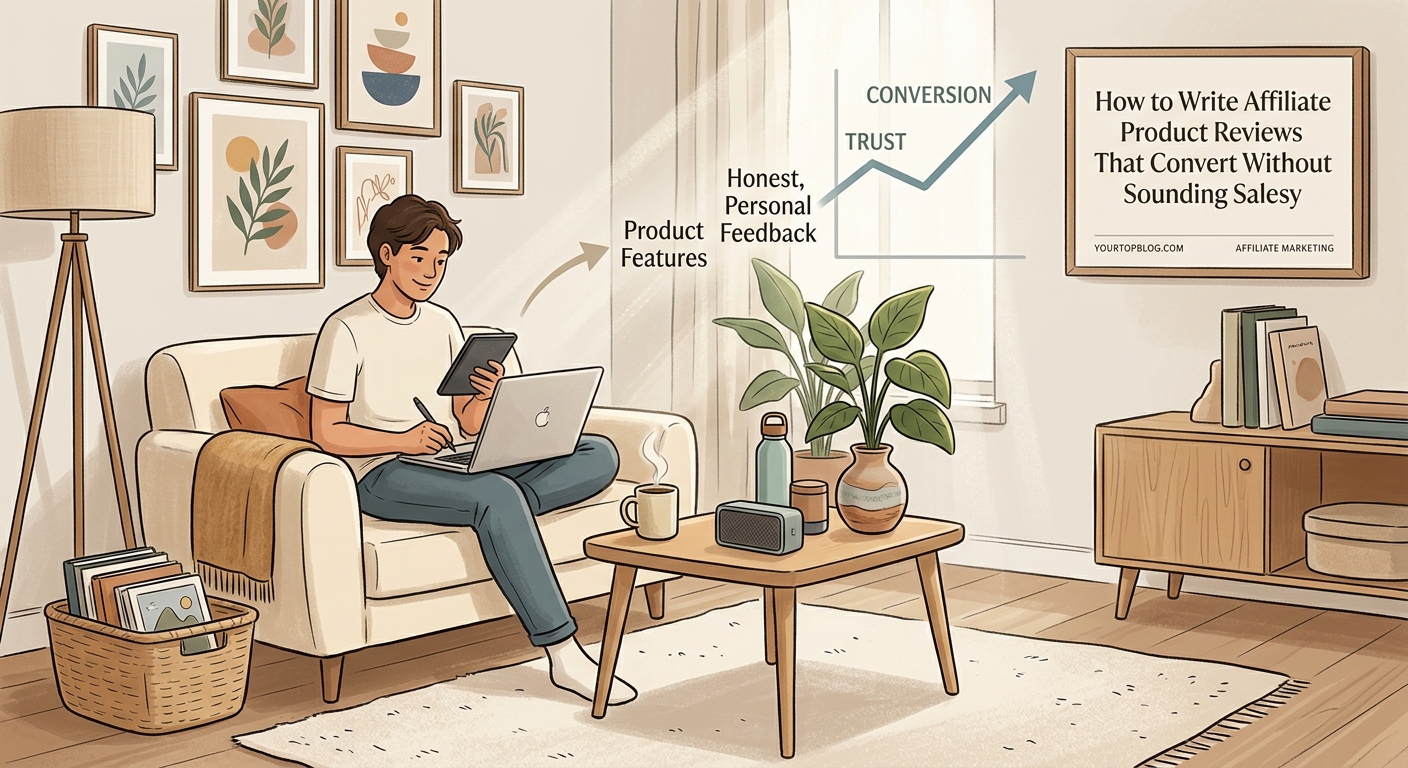
The reviews that convert treat readers like intelligent adults. They provide value first. The affiliate commission becomes a natural byproduct of helpful content.
Start with genuine experience

Never review a product you haven’t used. Period.
This isn’t just about ethics. It’s about survival. Readers ask detailed questions in comments. They email you for clarification. If you’re faking it, they’ll know.
Buy the product. Use it for at least two weeks. Take screenshots. Document your results. Note what frustrated you and what impressed you.
Real experience gives you specific details that generic reviews lack. You’ll mention the quirky interface bug in the settings menu. You’ll know exactly how long the setup process takes. You’ll have opinions about customer support response times.
These details separate you from the hundreds of reviewers who copied the product description and called it a review.
Structure your review around problems, not features
Nobody cares that a tool has 47 features. They care whether it solves their problem.
Start by identifying the exact pain point your reader faces. Get specific. “Email marketing” is too broad. “Getting subscribers to actually open your emails” hits harder.
Then show how the product addresses that specific problem. Use your experience to walk through the solution step by step.
Here’s the structure that works:
- Open with the problem your reader faces right now
- Explain why this problem matters (lost revenue, wasted time, missed opportunities)
- Introduce the product as one potential solution
- Show exactly how you used it to solve the problem
- Share your actual results with proof
- Address limitations and who shouldn’t buy it
- Provide a clear recommendation with next steps
This structure sells without selling. You’re helping someone make a decision, not pushing them toward a purchase.
Share real results with evidence
“This tool increased my conversions” means nothing without proof.
Show screenshots. Share analytics data. Include before and after comparisons. Give specific numbers with context.
Instead of: “I made more money with this tool.”
Write: “My affiliate earnings went from $340 in March to $890 in April after implementing the email sequences this tool provides. Here’s the dashboard screenshot showing the increase.”
The specificity does two things. It makes your claim believable. And it helps readers envision similar results for themselves.
Don’t cherry-pick only the best results. Share the full picture. If something took longer than expected, say so. If you hit obstacles, describe them.
Honesty about the journey makes your success more credible.
Be brutally honest about limitations
Every product has weaknesses. Pretending otherwise destroys trust.
List the genuine downsides. Talk about who shouldn’t buy this product. Mention the competitors who do certain things better.
This feels counterintuitive. Won’t criticism hurt conversions?
Actually, no. It does the opposite.
When you acknowledge flaws, readers trust your praise. They think: “This person isn’t just trying to make a commission. They’re giving me the real story.”
Plus, addressing objections upfront prevents buyer’s remorse. Someone who purchases despite knowing the limitations won’t blame you later.
Create a simple pros and cons section. Make both lists honest and specific.
| What works well | What needs improvement |
|---|---|
| Setup took 10 minutes with clear video tutorials | Mobile app crashes on older Android devices |
| Customer support responded in under 2 hours | Reporting dashboard feels cluttered |
| Integrates with 200+ tools including obscure ones | Pricing jumps significantly at 5,000 subscribers |
This table format makes scanning easy. Readers appreciate the balanced view.
Write for the skeptical reader
Assume your reader has been burned before. They’ve bought products that didn’t deliver. They’ve fallen for hype.
Address their skepticism directly. Acknowledge it. Then overcome it with evidence.
Use phrases like:
– “I was skeptical about this claim too, until I tested it myself”
– “This sounds too good to be true, so here’s what actually happened”
– “The marketing makes big promises, but here’s the reality”
This language shows you’re on their side. You’re the skeptical friend helping them avoid mistakes, not the salesperson trying to close a deal.
Compare honestly with alternatives
Readers are comparing options. Help them do it well.
Mention 2-3 competing products by name. Explain when each makes sense.
“Tool A works better if you’re just starting out and need simplicity. Tool B (the one I’m reviewing) makes more sense once you’re processing over 1,000 transactions monthly and need advanced automation.”
This approach positions you as an expert, not a shill. You’re helping readers find the right solution, even if it’s not the product you’re reviewing.
Paradoxically, this increases conversions. The right people buy. They stick around. They trust your future recommendations.
Wrong-fit customers who would have requested refunds never purchase in the first place.
Use strategic calls to action
You need calls to action. But they should feel helpful, not pushy.
Bad CTA: “BUY NOW! Limited time offer! Click here before it’s too late!”
Good CTA: “If this matches your needs, you can try it risk-free for 30 days here.”
The difference? The good version respects reader autonomy. It provides information and lets them decide.
Place CTAs naturally throughout the review:
– After explaining a major benefit
– Following a results screenshot
– At the end of the pros and cons section
– In the final recommendation paragraph
Don’t cluster them. Space them out. Each one should follow a logical point where a reader might think “okay, I’m interested.”
Add personal context that readers relate to
Generic reviews could have been written by anyone. Personal details make yours memorable.
Share why you needed this product. Describe the situation that led you to try it.
“I was managing three client sites and spending two hours daily on manual backups. I needed automation that actually worked.”
This context helps similar readers self-identify. They think: “That’s exactly my situation. If it worked for them, it might work for me.”
You can build even more trust by sharing content about growing your blog traffic using similar authentic strategies.
Answer the questions readers actually ask
Look at competitor reviews. Read their comments. Check forums and Reddit threads about the product.
What questions keep coming up?
Address these directly in your review. Create a FAQ section if needed.
Common questions to cover:
– How long does setup actually take?
– What happens after the trial ends?
– Can you cancel easily or is it a nightmare?
– Does customer support actually respond?
– What’s not included that you’d expect?
Answering these shows you understand your reader’s concerns. It also captures long-tail search traffic from people asking these specific questions.
Show the product in action
Text descriptions only go so far. Visual proof works better.
Include screenshots of:
– The dashboard or interface
– Your actual results or analytics
– The setup process
– Before and after comparisons
– Email receipts or payment confirmations
You don’t need fancy graphics. Simple, authentic screenshots work better than polished marketing images.
If you’re comfortable on camera, a short video walkthrough adds even more credibility. Seeing you use the product in real-time removes almost all skepticism.
Connect to broader monetization strategies
Your review shouldn’t exist in isolation. Connect it to your reader’s bigger goals.
If you’re reviewing an email tool, mention how it fits into a complete monetization strategy. Reference other income streams that work alongside affiliate marketing.
This positions you as someone who understands the full picture, not just individual products.
Price the value, not just the cost
Readers see the price tag. Your job is helping them understand the value.
Break down the ROI. Show the math.
“This costs $49 monthly. It saves me about 10 hours of work each month. I bill my time at $75 per hour for client work. That’s $750 in time saved, making the tool worth 15x its cost for my situation.”
This reframe helps readers evaluate whether the investment makes sense for their specific circumstances.
Update your reviews regularly
Products change. Features get added. Pricing shifts. Competitors improve.
Return to your review every 6-12 months. Add an update section at the top noting what’s changed.
“Update March 2024: They’ve added the automation feature I mentioned was missing. This significantly improves the value for larger teams.”
These updates serve two purposes. They keep your content accurate and helpful. And they signal to search engines that your content stays fresh and relevant.
Readers notice update dates too. A review from 2019 with no updates feels stale. The same review with a 2024 update note feels current.
Handle disclosure properly
You’re legally required to disclose affiliate relationships. But don’t hide it in tiny text at the bottom.
Put a clear, friendly disclosure near the top:
“Full transparency: This review contains affiliate links. If you purchase through them, I earn a small commission at no extra cost to you. I only recommend products I’ve personally used and genuinely find valuable.”
This straightforward approach actually builds trust. You’re being upfront about the business relationship while maintaining your standards.
Write for humans, optimize for search
Your review needs to rank in search results. But don’t sacrifice readability for SEO.
Include your target keywords naturally:
– In your opening paragraphs
– In a few subheadings
– Throughout the body where they fit naturally
– In image alt text
But never force it. If a keyword phrase sounds awkward, rephrase the sentence or skip it.
Search engines are smart enough to understand synonyms and context. They prioritize content that genuinely helps users.
If you’re building topical authority, consider how finding low competition keywords can help you rank reviews faster.
Test different approaches
Not every technique works for every audience or niche. Test variations.
Try different review lengths. Some audiences want 3,000-word deep analyses. Others prefer 800-word overviews.
Experiment with video vs. text. Add comparison tables or skip them. Test different CTA placements.
Track which reviews convert best. Look at time on page, scroll depth, and click-through rates. Double down on what works.
The data tells you what your specific audience responds to.
Build a review portfolio
One review rarely makes significant income. Ten reviews start generating real revenue. Fifty reviews can replace a salary.
Choose products strategically:
– Mix high-ticket and low-ticket items
– Cover beginner and advanced tools
– Include monthly subscriptions and one-time purchases
– Review products in complementary categories
This variety captures readers at different stages. Someone not ready for the $500 course might buy the $30 tool. Six months later, they’re ready for bigger purchases.
Your review portfolio becomes a monetization engine. New readers find one review. They trust your judgment. They return for more recommendations.
This compounds over time, much like the strategies used by successful bloggers who’ve scaled their traffic significantly.
Turn reviews into comparison posts
Once you’ve reviewed multiple products in the same category, create comparison content.
“Best email marketing tools for bloggers” becomes a new post that links to your individual reviews. This captures broader search traffic and guides readers to the right specific review.
Comparison posts also let you recommend different products for different use cases. You’re not picking one winner. You’re helping readers find their perfect match.
Writing reviews that actually help
The best affiliate reviews don’t feel like affiliate reviews. They feel like advice from a knowledgeable friend.
That friend has tested the options. They know the pitfalls. They’ll tell you the truth even if it means you don’t buy anything today.
This approach takes more work upfront. You actually have to use products. You need to gather real data. You must think critically about limitations.
But it pays off in ways that pushy reviews never do. Your audience grows. Your recommendations carry weight. Your conversion rates climb because the right people buy at the right time.
Start with one honest, thorough review. Apply these principles. Track the results. Then write another.
Over time, you’ll build a reputation as someone who provides genuine value. The affiliate commissions follow naturally from that foundation of trust.