
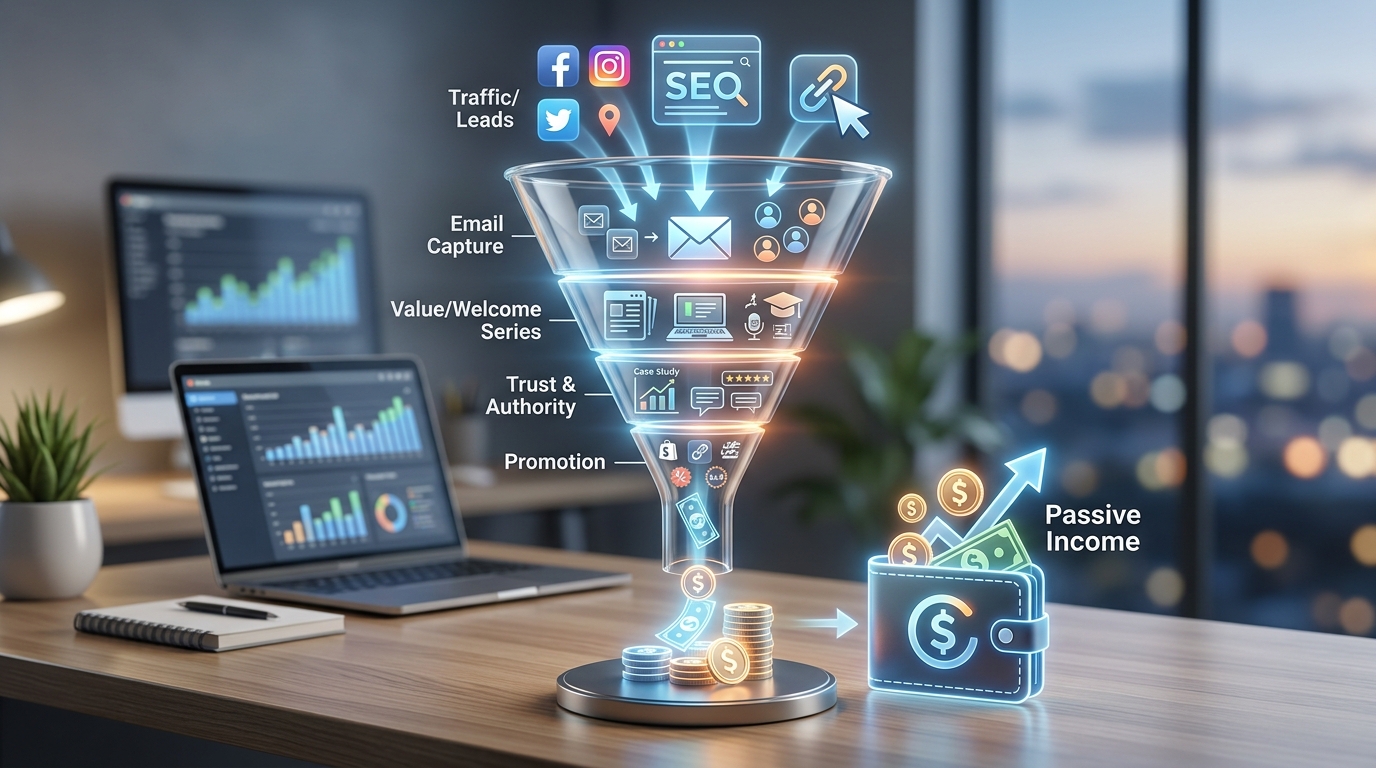
You’ve spent months creating content, driving traffic, and building your audience. But when it comes to actually making money from affiliate offers, the results feel disappointing. The problem isn’t your traffic or your offers. It’s that you’re missing the bridge between the two: a properly structured email funnel that turns curious subscribers into eager buyers.
An affiliate marketing email funnel automates your sales process by nurturing subscribers through targeted sequences that build trust, demonstrate value, and strategically present offers. With the right structure, you can convert 15-25% of engaged subscribers into buyers while generating consistent [passive income](https://en.wikipedia.org/wiki/Passive_income). This guide shows you how to build each component from scratch, avoiding common mistakes that kill conversions.
Why Most Affiliate Emails Never Convert
Most people treat their email list like a broadcast channel. They send the same promotional message to everyone and wonder why open rates tank and unsubscribes spike.
The truth is simpler than you think.
People don’t buy from strangers. They buy from sources they trust. Your email funnel needs to build that trust systematically before you ever mention an affiliate link.
I learned this the hard way. My first email campaign promoting a course got a 2% click rate and zero sales. The second attempt, after restructuring my funnel with a proper nurture sequence, converted at 18% and generated over $3,000 in commissions.
The difference wasn’t the offer. It was the journey I took subscribers on before presenting it.
The Four Essential Stages of Your Funnel
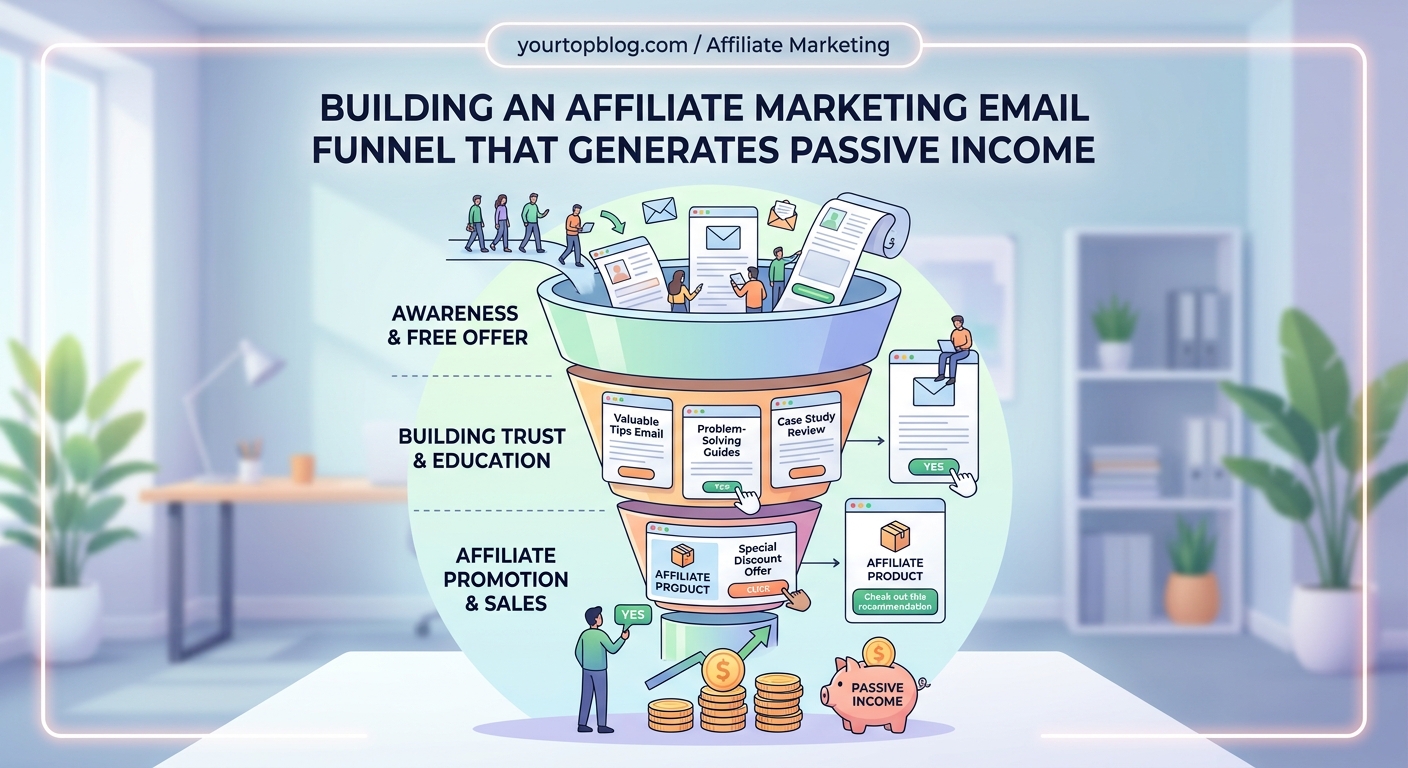
Every profitable affiliate marketing email funnel follows the same basic structure. Miss one stage and your conversions suffer.
Stage 1: The Welcome Series
Your welcome series runs immediately after someone subscribes. This is where you set expectations, deliver your promised lead magnet, and start building rapport.
Most marketers rush this part. They send one welcome email and jump straight into promotions. That’s leaving money on the table.
Your welcome series should run 3-5 emails over the first week. Each email should accomplish one specific goal.
Stage 2: The Value Phase
This is where you establish authority and trust. Send educational content that solves real problems your audience faces. No pitches yet.
Share case studies, tutorials, and insights. Reference your own experiences. Make subscribers look forward to your emails because they always get something useful.
This phase typically runs 5-7 emails over two weeks.
Stage 3: The Bridge
The bridge phase connects your educational content to your affiliate offer. You’re not selling yet, but you’re introducing the concept of the solution.
Talk about the types of tools or strategies that work. Mention what to look for in a good product. Share your criteria for recommendations.
This primes subscribers to be receptive when you finally present your specific affiliate offer.
Stage 4: The Promotion
Now you present your affiliate offer with confidence. Because you’ve built trust and established context, subscribers are ready to hear your recommendation.
Your promotional sequence should run 4-6 emails over one week. Each email tackles a different angle: benefits, objections, case studies, urgency, and final call.
Building Your First Funnel Step by Step
Let me walk you through creating each component. Start with the foundation and build up.
-
Choose your core affiliate offer first. Everything in your funnel should align with this end goal. Pick a product you’ve actually used and believe in. Your enthusiasm will show in your writing.
-
Create a lead magnet that attracts your ideal buyer. If you’re promoting a WordPress theme, your lead magnet might be “10 Design Mistakes Killing Your Blog Conversions.” The people who want that guide are perfect prospects for your theme offer.
-
Map out your email sequence on paper. Write down the purpose of each email before you write a single word. This prevents rambling and keeps your funnel focused.
-
Write your welcome series. Email 1 delivers the lead magnet and sets expectations. Email 2 shares your story and builds connection. Email 3 asks a question to encourage replies and boost engagement.
-
Develop your value content. These emails should be genuinely helpful. If someone only read these and never bought anything, they should still feel like subscribing was worthwhile. That’s how you build an audience that sticks around for passive income streams over time.
-
Craft your bridge emails. Introduce concepts and frameworks that make your affiliate offer the logical next step. If you’re promoting an SEO tool, teach about keyword research principles first.
-
Write your promotional sequence. Be direct about what you’re recommending and why. Share specific results you’ve achieved. Address common objections head-on.
-
Set up your automation. Use an email platform that lets you create sequences with delays between emails. Most platforms make this straightforward.
The Anatomy of High-Converting Affiliate Emails
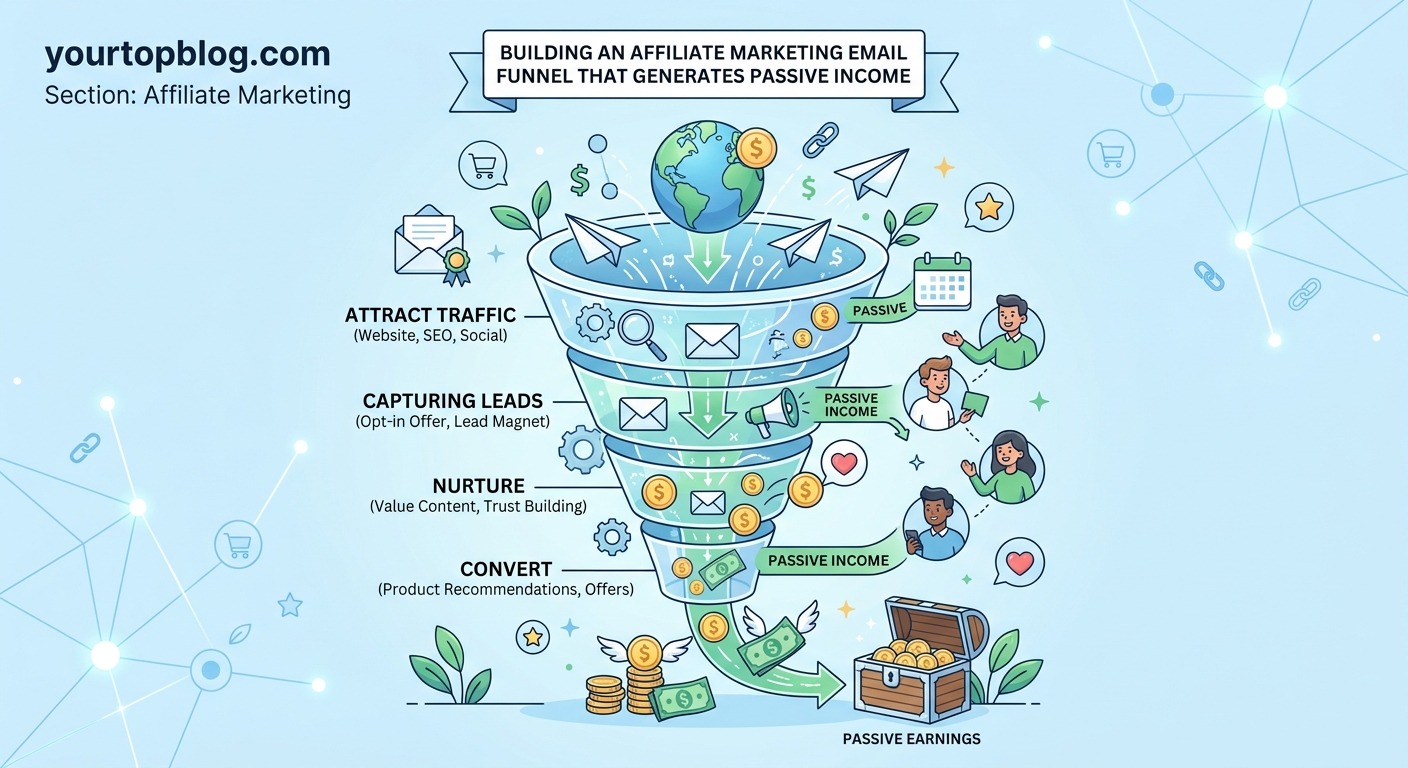
Not all emails perform equally. Certain elements consistently boost conversions.
Subject lines that spark curiosity work better than hype. Compare “AMAZING TOOL YOU NEED” with “The tool I use every morning before coffee.” The second one feels personal and intriguing.
Stories beat features every time. Don’t list what a product does. Tell a story about how it solved a specific problem for you or someone else.
One clear call to action per email. Multiple links and requests confuse readers. Pick one action you want them to take and make it obvious.
Personal language creates connection. Write like you’re emailing a friend. Use “you” and “I” liberally. Avoid third-person corporate speak.
Specific numbers build credibility. Instead of “this increased my traffic,” say “this took me from 1,200 to 4,800 monthly visitors in 90 days.”
Here’s what a simple conversion-focused email structure looks like:
| Section | Purpose | Length |
|---|---|---|
| Opening | Hook attention with a relatable problem or surprising statement | 2-3 sentences |
| Story/Example | Illustrate the problem or solution with a concrete scenario | 1-2 paragraphs |
| Transition | Connect the story to your recommendation | 1 paragraph |
| Recommendation | Present your affiliate offer with specific benefits | 2-3 paragraphs |
| Call to Action | Clear next step with linked button or text | 1-2 sentences |
| P.S. | Reinforce urgency or add bonus detail | 1 sentence |
Segmentation Makes Everything Better
Sending the same emails to everyone is a missed opportunity. People at different stages need different messages.
Create segments based on behavior. Someone who clicked your last three emails is more engaged than someone who hasn’t opened anything in weeks.
Send your most aggressive promotions to highly engaged subscribers. They’re ready to buy.
For less engaged subscribers, send more value content before promotional emails. Win back their attention first.
You can also segment by interest. If someone clicked a link about SEO tools but ignored your email marketing content, that tells you something valuable.
Tag subscribers based on what they click. Then send follow-up sequences tailored to those interests.
This approach consistently doubles conversion rates compared to one-size-fits-all campaigns.
Common Mistakes That Kill Your Funnel
I’ve reviewed hundreds of affiliate funnels. The same problems show up repeatedly.
Mistake 1: Promoting too soon. You need at least 3-4 value emails before your first promotion. Build trust first.
Mistake 2: Weak lead magnets. A generic “10 tips” PDF won’t attract serious buyers. Create lead magnets that solve one specific, painful problem your target audience faces.
Mistake 3: No bridge phase. Jumping from educational content straight to “buy this product” feels jarring. Ease subscribers into the idea of solutions.
Mistake 4: Ignoring mobile formatting. Over 60% of emails get opened on phones. Keep paragraphs short. Use plenty of white space. Test on mobile before sending.
Mistake 5: Not tracking performance. You should know the open rate, click rate, and conversion rate of every email. This data tells you what’s working and what needs fixing.
Mistake 6: Giving up too early. Your first funnel won’t be perfect. Test different subject lines, email lengths, and promotional angles. Optimization happens over time.
The biggest mistake I see is treating email like a megaphone instead of a conversation. Your subscribers are real people with real problems. Talk to them like humans, not marketing targets. When you genuinely care about helping first and selling second, the conversions take care of themselves.
Optimizing for Maximum Conversions
Once your basic funnel is running, small tweaks can dramatically improve results.
Test your subject lines systematically. Send two versions to small segments and use the winner for the rest of your list. A better subject line can boost opens by 30-40%.
Experiment with email length. Some audiences prefer short, punchy emails. Others engage more with longer, story-driven content. Test both approaches.
Try different sending times. Tuesday and Thursday mornings often perform well, but your audience might be different. Track when you get the best engagement.
Add urgency authentically. Limited-time bonuses or price increases create genuine urgency. Fake countdown timers destroy trust.
Use P.S. sections strategically. Many people skim to the bottom of emails. Your P.S. is prime real estate for reinforcing your call to action or adding a compelling detail.
Include social proof. Testimonials, user numbers, or case study results make your recommendations more credible. Just make sure they’re real and relevant.
Scaling Your Funnel Across Multiple Offers
Once you have one profitable funnel, you can replicate the system for other affiliate products.
The key is maintaining separate sequences for different product categories. Someone interested in high-converting affiliate programs for bloggers might not care about your web hosting recommendations.
Create interest-based funnels triggered by specific opt-ins or link clicks. This lets you run multiple specialized funnels simultaneously without overwhelming subscribers.
Your main list receives general value content. When someone shows interest in a specific topic by clicking a link, they enter a specialized sequence for that category.
This approach lets you promote multiple products without bombarding everyone with irrelevant offers.
Technical Setup Without the Headaches
You don’t need expensive tools to start. Most email platforms offer the features you need at reasonable prices.
Essential features to look for:
- Automation sequences with time delays
- Tagging and segmentation capabilities
- A/B testing for subject lines
- Basic analytics (opens, clicks, conversions)
- Integration with your website or landing page builder
Popular options include ConvertKit, ActiveCampaign, and MailerLite. All offer free trials so you can test before committing.
Set up conversion tracking from day one. Most affiliate programs provide tracking pixels or parameters you can add to your links. This lets you see exactly which emails generate sales.
Connect your email platform to your website so new subscribers automatically enter your funnel. Manual imports waste time and create delays.
Content That Keeps Subscribers Engaged
Your funnel only works if people actually read your emails. That means every message needs to deliver value.
Mix up your content types. Send case studies one day, tutorials the next, then personal stories. Variety keeps things interesting.
Address real problems your audience faces. The more specific, the better. “How to rank for competitive keywords” beats “SEO tips” every time, especially if you’re targeting people who want to find low competition keywords.
Share your failures along with successes. Authenticity builds stronger connections than perfect highlight reels.
Ask questions and encourage replies. When subscribers respond to your emails, it signals engagement to email providers and improves deliverability.
Reference current events or seasons when relevant. Timely content feels more personal and immediate.
Measuring What Actually Matters
Vanity metrics feel good but don’t pay bills. Focus on numbers that directly impact revenue.
Open rate tells you if your subject lines work. Aim for 20-30% for engaged subscribers.
Click rate shows whether your email content compels action. A healthy click rate is 3-8% of total recipients.
Conversion rate is the only metric that truly matters. This is the percentage of people who click your affiliate link and actually buy. Track this religiously.
Revenue per subscriber tells you the real value of your list. Calculate total affiliate commissions divided by total subscribers. Growing this number means your funnel is improving.
Unsubscribe rate should stay under 0.5% per email. Higher rates mean you’re promoting too aggressively or attracting the wrong subscribers.
Set up a simple spreadsheet to track these metrics for each email. Patterns will emerge that guide your optimization efforts.
Troubleshooting Low Performance
If your funnel isn’t converting, systematic diagnosis usually reveals the problem.
Low open rates? Your subject lines need work. Test more curiosity-driven approaches. Also check your sender name. Emails from “John at BlogName” often outperform “BlogName Newsletter.”
Good opens but low clicks? Your email content isn’t compelling enough. Strengthen your stories, make benefits clearer, or simplify your call to action.
High clicks but no sales? The problem might be your affiliate offer, not your emails. Make sure you’re promoting products your audience actually wants and can afford.
High unsubscribe rates? You’re probably promoting too frequently or too aggressively. Add more value content between promotional emails.
Overall low engagement? Your lead magnet might be attracting the wrong people. Revisit who you’re targeting and whether your opt-in offer aligns with your affiliate products.
Advanced Strategies for Experienced Marketers
Once you’ve mastered the basics, these tactics can boost results further.
Create mini-funnels for specific objections. If someone clicks your affiliate link but doesn’t buy, tag them and send a follow-up sequence addressing common purchase barriers.
Use surveys to refine targeting. Ask subscribers about their biggest challenges. Their answers help you customize future content and offers.
Implement win-back campaigns. When someone hasn’t opened emails in 60 days, send a re-engagement sequence. Offer a fresh lead magnet or ask what content they want to see.
Add video content. Short personal videos in emails can dramatically boost engagement. Even a simple phone recording works.
Partner with other creators. Guest appearances in each other’s funnels expose you to new audiences. Just make sure there’s genuine alignment in values and audience.
Test different promotional intensities. Some audiences respond well to 3-4 promotional emails per offer. Others prefer a single, longer email. Find what works for your people.
Building Trust That Lasts Beyond One Sale
The real power of an affiliate marketing email funnel isn’t just the immediate commissions. It’s the relationship you build with subscribers.
When you consistently deliver value and only recommend products you truly believe in, people start to trust your judgment. They open your emails first. They buy based on your recommendation alone.
This trust compounds over time. Your first funnel might convert at 10%. Six months later, with an engaged audience that knows you deliver, that same funnel might convert at 25%.
The marketers making serious money from affiliate email aren’t the ones with the biggest lists. They’re the ones with the most engaged, trusting audiences.
Build that trust by being selective about what you promote. Turn down affiliate opportunities that don’t serve your audience. Be honest about limitations of products you recommend.
Your reputation is worth more than any single commission.
Making Your Funnel Work for You
An affiliate marketing email funnel transforms sporadic income into predictable revenue. New subscribers automatically enter your proven system. They receive the same carefully crafted sequence that’s already converted hundreds of others.
You write the emails once. They work for months or years.
That’s the definition of passive income.
Start with one simple funnel for your best affiliate offer. Get it working. Then replicate the system for other products.
The initial setup takes effort. But once it’s running, your funnel generates commissions while you sleep, travel, or work on growing your blog traffic to feed more subscribers into your system.
The best time to build your first funnel was six months ago. The second best time is today.