
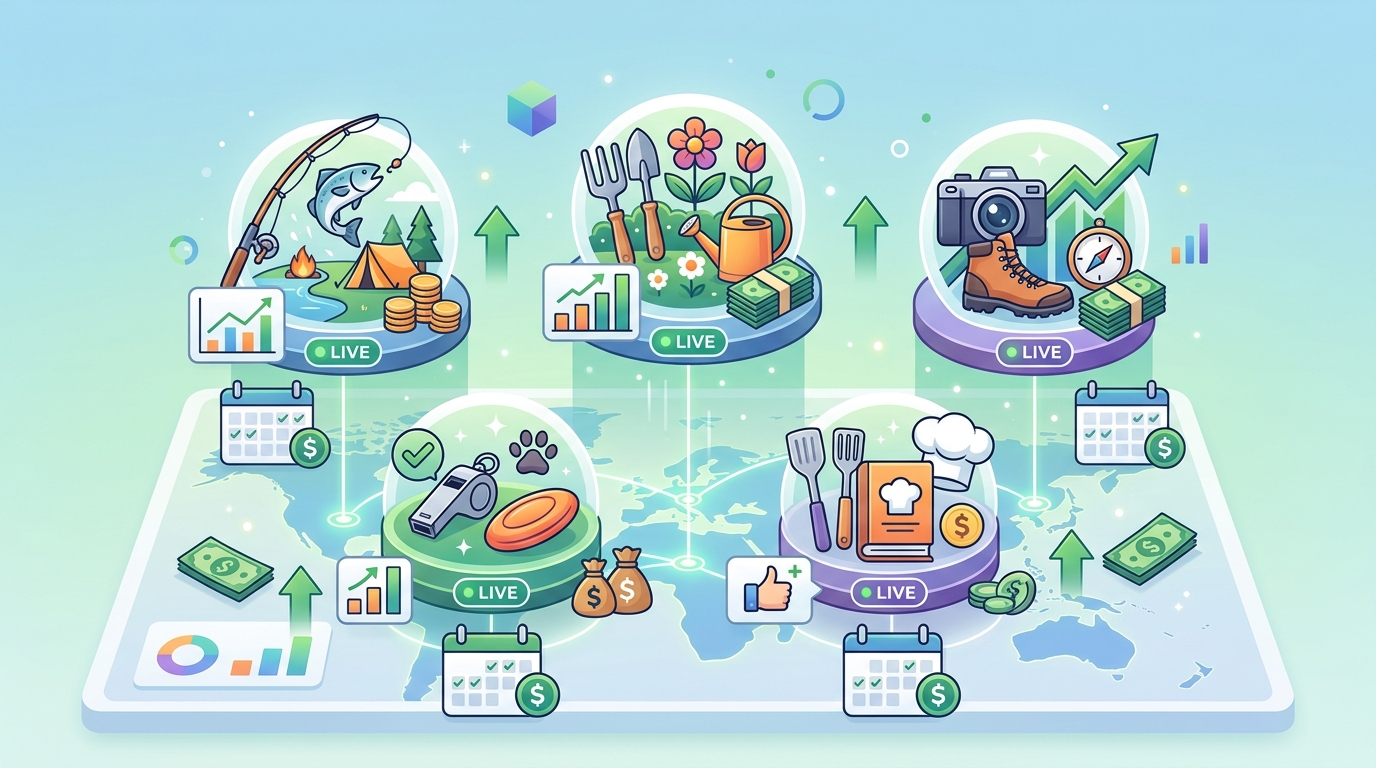
Building a website that generates real income sounds like a dream, but thousands of people are doing it right now. They’re not tech wizards or marketing geniuses. They’re regular folks who found a profitable angle, created helpful content, and set up the right monetization systems.
The best part? Many of these sites run on autopilot once you set them up correctly.
Niche websites that make money focus on specific audiences with clear problems. They combine organic traffic from search engines with multiple revenue streams like [affiliate marketing](https://en.wikipedia.org/wiki/Affiliate_marketing), display ads, and digital products. Success requires upfront effort in content creation and SEO, but maintenance drops significantly after the first 6-12 months of consistent publishing.
What makes a niche website profitable
A profitable niche website solves a specific problem for a specific audience. That’s it.
You’re not trying to be everything to everyone. You’re helping dog owners train their puppies, or teaching apartment dwellers how to grow herbs indoors, or showing new parents how to sleep train their babies.
The money comes from three main sources:
- Display advertising networks like Google AdSense or Mediavine
- Affiliate commissions from products you recommend
- Your own digital products or services
The magic happens when you combine all three. A site earning $500 from ads, $1,200 from affiliates, and $800 from a digital course suddenly brings in $2,500 monthly. That’s enough to cover a car payment, student loans, or fund your next vacation.
But here’s what separates winners from failures. Profitable sites target topics where people actually search for answers AND are willing to spend money on solutions.
A site about “budget camping gear” has both. People search for it constantly, and they’re ready to buy tents, sleeping bags, and cooking equipment. A site about “interesting cloud formations” might get traffic, but monetization will be brutal because visitors aren’t in buying mode.
The four proven revenue models that work
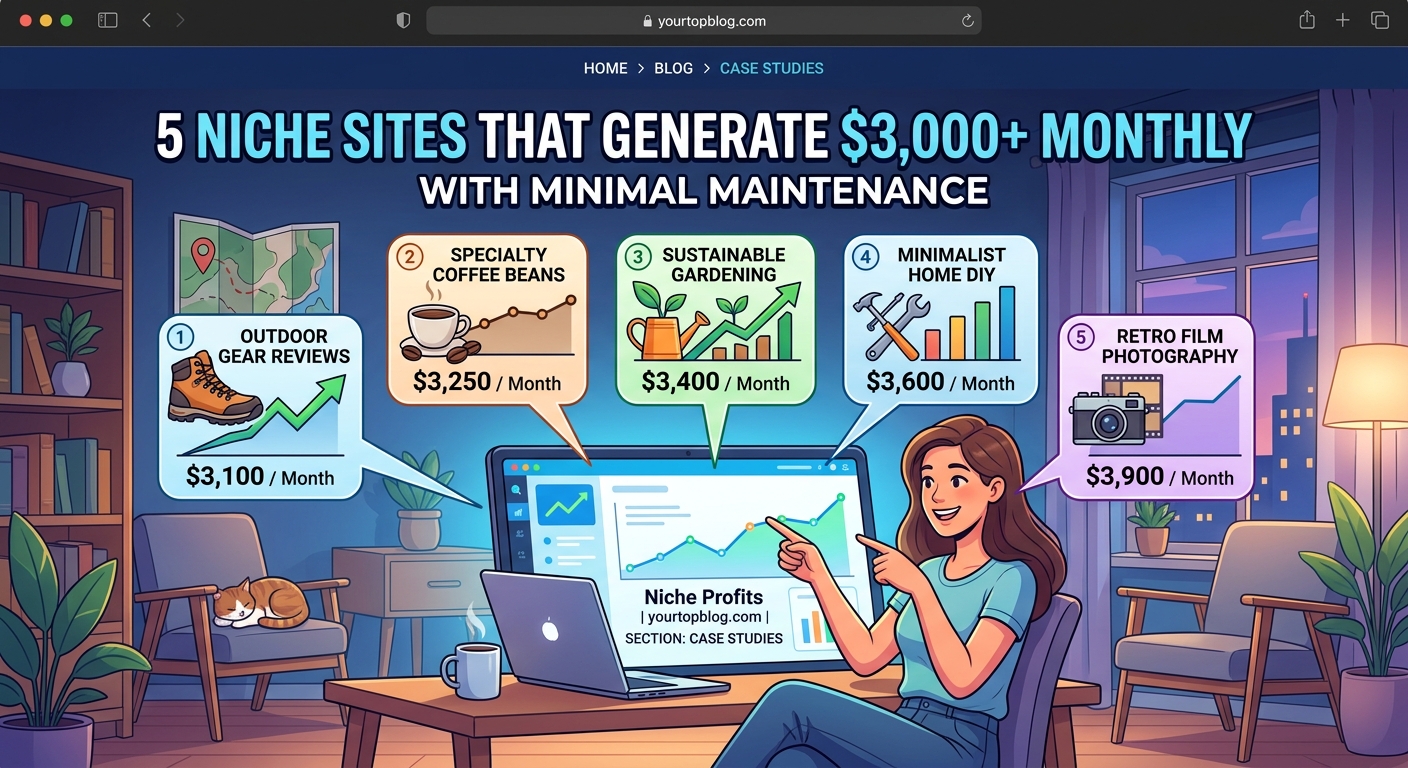
Let me break down how each monetization method actually works in practice.
Display advertising pays you when visitors see or click ads on your site. You need traffic for this to work. Lots of it. Getting approved for Google AdSense is the first step, but premium networks like Mediavine (requiring 50,000 monthly sessions) pay 3-5 times more per visitor.
A site with 50,000 monthly pageviews might earn $150-300 with AdSense, but $800-1,500 with Mediavine. Same traffic, different revenue. That’s why scaling traffic matters so much in the display ad model.
Affiliate marketing pays commissions when readers buy products you recommend. Amazon Associates is the easiest starting point, paying 1-10% depending on product category. But specialized affiliate programs often pay much better.
A camping gear site promoting a $200 tent through Amazon earns $6-12. That same site promoting web hosting through Bluehost’s affiliate program earns $65-130 per signup. The difference is massive.
Digital products include ebooks, courses, templates, and tools you create once and sell repeatedly. A meal planning site might sell a $27 ebook with 52 weeks of recipes. Sell 50 copies monthly and you’ve added $1,350 to your income.
The upfront work is significant, but margins are incredible. You keep 95% of revenue after payment processing fees.
Sponsored content involves brands paying you to write articles featuring their products. A gardening site with 30,000 monthly visitors might charge $300-800 per sponsored post. Two posts monthly adds $600-1,600.
How to pick a niche that actually makes money
Choosing the right niche determines everything. Pick wrong and you’ll work twice as hard for half the results.
Start by listing topics where you have genuine knowledge or strong interest. You’ll be creating 50-100 articles minimum, so pick something you can actually write about without wanting to quit after article 15.
Then validate commercial viability:
- Open Google and search for product reviews in your niche
- Check if Amazon has a dedicated category for products in this space
- Search “best [niche] products 2024” and see if established sites are ranking
- Look for affiliate programs related to your topic on ShareASale or CJ Affiliate
- Verify people are actually searching using free tools like Google Keyword Planner
If you see established sites ranking for product-focused keywords, affiliate programs available, and consistent search volume, you’ve found a viable niche.
Red flags include:
- No clear products or services to recommend
- Extremely low search volume (under 1,000 monthly searches for your main topics)
- Dominated by massive brands like WebMD, CNN, or government sites
- Topics that change too rapidly (cryptocurrency trends, viral TikTok challenges)
Here’s a simple validation table:
| Niche Signal | Good Sign | Warning Sign |
|---|---|---|
| Search Volume | 10,000+ monthly searches across 20+ keywords | Under 1,000 total monthly searches |
| Competition | Mix of small blogs and medium sites ranking | Only massive brands in top 10 results |
| Products | Clear affiliate programs and physical products | No obvious monetization path |
| Longevity | Stable interest over 3+ years | Trending topic with 6-month lifespan |
Building your site the right way from day one
Technical setup matters less than most beginners think, but getting a few things right saves headaches later.
WordPress is the standard choice for good reason. It’s free, flexible, and every tool integrates with it. Choosing between WordPress and other platforms is easier when you understand that 43% of all websites run on WordPress.
For hosting, budget $3-10 monthly starting out. Shared hosting from providers like SiteGround or Bluehost works fine until you hit 30,000+ monthly visitors. Then upgrade to managed WordPress hosting.
Pick a domain name that’s memorable and relevant to your niche. “BudgetCampingPro.com” immediately tells visitors what you’re about. “JohnsBlog2024.com” tells them nothing.
Install a fast, clean theme. GeneratePress and Astra are both excellent free options. Avoid themes with tons of built-in features you’ll never use. They just slow down your site.
Essential plugins:
- Yoast SEO or Rank Math for on-page optimization
- WP Rocket or LiteSpeed Cache for speed
- Pretty Links for managing affiliate links
- MonsterInsights for Google Analytics integration
That’s it. Don’t install 47 plugins. Every extra plugin is another thing that can break or slow down your site.
Creating content that ranks and converts
Content is where most niche sites win or lose. You need articles that rank in Google AND convince readers to click your affiliate links or buy your products.
Start with keyword research. Finding low competition keywords is the foundation of everything. You’re looking for search terms with decent volume (500+ monthly searches) but lower competition.
Tools like Ubersuggest, Ahrefs, or SEMrush help, but you can start with Google’s autocomplete. Type “best camping” and Google shows you “best camping tents,” “best camping chairs,” “best camping stoves.” Each is a potential article.
Write comprehensive guides that actually answer the searcher’s question. A “best camping tents under $200” article should:
- List 7-10 specific tent models with real pros and cons
- Include comparison tables showing specs side by side
- Explain what features matter for different camping styles
- Link to where readers can buy each tent (your affiliate links)
- Answer common questions about tent setup, durability, and sizing
Aim for 1,500-2,500 words for product roundups. For informational content like “how to waterproof a tent,” 800-1,200 words usually covers it thoroughly.
“The articles that make me the most money aren’t always the longest. They’re the ones that match search intent perfectly and make it easy for readers to take action.” – Sarah Chen, owner of OutdoorGearLab earning $12,000 monthly
Your on-page SEO needs to be solid but not obsessive. Include your target keyword in the title, first paragraph, a few subheadings, and naturally throughout. Don’t force it 47 times. Google is smarter than that now.
Internal linking helps both SEO and user experience. When you mention tent stakes in your tent review article, link to your detailed “best tent stakes” article. This keeps readers on your site longer and helps Google understand your content structure.
The realistic timeline to profitability
Most niche websites take 6-12 months to generate meaningful income. Anyone promising $5,000 in month two is selling you something.
Here’s what a realistic growth path looks like:
Months 1-3: You’re publishing 2-4 articles weekly, building your foundation, and seeing minimal traffic. Maybe 500-2,000 monthly visitors. Revenue is usually $0-50. This is normal. Don’t panic.
Months 4-6: Google starts trusting your site. Traffic grows to 3,000-8,000 monthly visitors. Some articles begin ranking on page 2-3. Revenue might hit $100-300 monthly if you’ve set up affiliates and ads.
Months 7-9: Your best articles climb to page 1. Traffic jumps to 10,000-25,000 monthly visitors. Revenue accelerates to $400-1,200 as you have more content working for you. This is where things get exciting.
Months 10-12: Compounding kicks in. Old articles gain authority and rank higher. New articles rank faster because your domain has credibility. Traffic reaches 25,000-50,000+ monthly visitors. Revenue hits $1,000-3,000+ monthly.
The exact numbers vary wildly based on your niche, content quality, and monetization methods. A food blogger might see different results than a tech reviewer, but the general timeline holds true.
Consistency matters more than perfection. Publishing one solid article weekly for 12 months beats publishing five mediocre articles one month and then nothing for three months.
Stacking multiple income streams without overwhelming readers
The sites earning $3,000+ monthly rarely rely on just one revenue source. They combine multiple streams intelligently.
Start with display ads once you have consistent traffic. Even if you’re only approved for AdSense initially, it’s passive income that requires zero ongoing effort. Avoid common AdSense mistakes that kill your earnings.
Add affiliate marketing from day one. Every product recommendation should include your affiliate link. Choose affiliate programs that actually pay well rather than just defaulting to Amazon for everything.
Introduce digital products around month 6-9 when you understand your audience’s biggest pain points. A $19 ebook or $47 mini-course can add substantial income without requiring inventory or shipping.
Stacking revenue models works when each serves a different purpose:
- Display ads monetize browsers who aren’t ready to buy
- Affiliate links serve readers actively shopping
- Digital products help your most engaged fans go deeper
Don’t bombard readers with sales pitches. A well-placed affiliate link in a helpful product review converts better than 17 links scattered throughout an article.
Scaling traffic without burning out
Traffic growth separates hobby sites from income-generating assets. You need volume for this to work.
SEO is your primary traffic engine. Understanding why your posts aren’t ranking helps you fix the issues holding you back.
But SEO alone isn’t enough. Diversify with free traffic sources like:
- Pinterest for visual niches (food, home decor, fashion, travel)
- YouTube for tutorial-heavy topics (tech, fitness, DIY)
- Email marketing for repeat visitors and launches
- Reddit and niche forums for community building
Building an email list gives you a direct line to your audience. A site with 30,000 monthly visitors and 5,000 email subscribers will always outperform a site with 50,000 visitors and no list.
Why? Because you can promote new content, affiliate deals, and product launches directly to people who already trust you.
The maintenance requirement drops significantly after your first year. You’re updating old content quarterly, publishing 1-2 new articles weekly (down from 3-4), and monitoring analytics monthly instead of daily.
Common mistakes that kill niche site income
I’ve seen the same errors destroy potentially profitable sites over and over.
Picking niches with no commercial intent. A site about “interesting historical facts” might get traffic, but monetization is nearly impossible. People aren’t buying anything related to random history trivia.
Giving up too early. Month 4 feels brutal. You’ve published 30 articles and earnings are $47. Most people quit here, right before the hockey stick growth starts.
Ignoring SEO basics. You can’t just write and hope Google finds you. Targeting the right keywords and optimizing your content matters enormously.
Over-monetizing too soon. Slapping ads on every pixel and inserting 23 affiliate links in a 600-word article destroys user experience. Readers leave, Google notices, rankings drop.
Never updating old content. Your article about “best camping tents 2022” won’t rank in 2024. Update it annually with current products and information.
Focusing only on traffic. A site with 50,000 visitors earning $400 has a monetization problem, not a traffic problem. Fix your conversion strategy before obsessing over more traffic.
Here’s what works versus what doesn’t:
| Strategy | Works | Doesn’t Work |
|---|---|---|
| Content Volume | 50-100 quality articles | 300 thin, rushed articles |
| Keyword Targeting | Specific long-tail keywords | Broad, impossible-to-rank terms |
| Monetization | 2-3 complementary revenue streams | 7 different ad networks cluttering pages |
| Publishing Schedule | Consistent 2-4 posts weekly | Random bursts of 10 posts then silence |
Real examples of profitable niche sites
Let me show you what’s actually working right now.
BudgetBytes.com teaches people to cook cheap, healthy meals. The site generates income through display ads, affiliate links to kitchen equipment, and a premium meal planning app. Monthly revenue exceeds $40,000 with a tiny team.
The secret? Extremely specific content. Not “cheap dinner ideas” but “15 meals under $5 that take 20 minutes.” That specificity attracts the right audience and ranks in Google.
TheWirecutter.com (now owned by the New York Times) started as a simple product review site. They tested products thoroughly, wrote honest reviews, and earned affiliate commissions. Before the acquisition, the site generated $150,000+ monthly from a small team.
Their approach was quality over quantity. They’d publish one incredibly detailed review rather than 10 shallow ones.
NerdWallet.com helps people make smart financial decisions. They earn through credit card affiliate commissions, display ads, and lead generation for financial products. Annual revenue exceeds $400 million.
They started small, focusing on credit card comparisons and personal finance basics. The niche had clear commercial intent and high-value affiliate programs.
You don’t need to build the next NerdWallet. A site earning $2,000-5,000 monthly is life-changing for most people. That’s a car payment, rent, or the freedom to work part-time at your day job.
Maintaining momentum after the initial push
The first 100 articles are the hardest. You’re writing constantly, seeing minimal results, and wondering if this will ever work.
Then something shifts. Articles start ranking. Traffic grows. Income appears. The work gets easier because you’re not starting from zero anymore.
Maintenance mode looks different for everyone, but here’s a sustainable approach:
- Publish 1-2 new articles weekly (down from 3-4 in the growth phase)
- Update your top 20 performing articles quarterly
- Monitor analytics monthly to spot trends and opportunities
- Test new monetization methods twice yearly
- Refresh outdated content annually
Growing from zero to significant traffic requires intensity. Maintaining that traffic requires consistency, not constant hustle.
Many successful niche site owners spend 5-10 hours weekly on their sites after the first year. That’s one weekend morning or a few evenings. The income continues because you’ve built systems that work without constant intervention.
Your path to a profitable niche website
Building a niche website that generates real income is absolutely possible. You don’t need special skills, a huge budget, or connections in the industry.
You need a viable niche, consistent content creation, solid SEO fundamentals, and patience to let compound growth work its magic.
Start today by choosing your niche and publishing your first article. Then publish another next week. And another the week after that. In 12 months, you’ll have a real asset generating income while you sleep.
The websites earning $3,000+ monthly right now all started with someone publishing their first article and wondering if anyone would ever read it. They kept going anyway. That’s the only real secret.